
Marie Antoinette and Louis XVI returned to Fontainebleau yesterday—not as spectral symbols of a collapsing monarchy, but through the rooms, objects and entertainments that shaped their life at the château. Marie-Antoinette et Louis XVI à Fontainebleau: Splendeur et douceur de vivre opened on 11 October and runs until 25 January 2027.
The exhibition brings together more than 120 portraits, drawings, sculptures and decorative objects, with loans from about twenty French and international institutions. Rather than treating Fontainebleau as a backdrop, the curators use the palace itself as primary evidence. The royal couple’s surviving apartments and pleasure rooms remain embedded in the route, turning architecture into part of the historical argument.
A court reconstructed through place
Marie Antoinette and Louis XVI made seven journeys to Fontainebleau between 1774 and 1786. Those stays combined political obligations with hunting, theatre, music and the carefully staged sociability of court. The exhibition follows that rhythm through spaces altered for the couple, including the Turkish boudoir, the silver boudoir, the Queen’s grand cabinet, the King’s powder room and the Buffets Room.
Designed or transformed under architects Richard Mique, Nicolas-Marie Potain and Pierre Rousseau, these interiors show how royal identity was expressed through comfort as much as ceremony. The display sets them beside works lent by Versailles, the Louvre, the Bibliothèque nationale de France and Lisbon’s Gulbenkian Museum. That combination makes the show less a parade of treasures than a reconstruction of how taste, leisure and authority occupied the same rooms.
The focus on theatre and music is especially telling. These were not decorative sidelines, but social systems in which rank could be observed, negotiated and displayed. By following performances, furnishings and private retreats together, the exhibition asks how ceremony softened into pleasure without ever losing its political charge.
Before the Revolution became the whole story
The title’s “splendour and sweetness of life” risks sounding nostalgic, but the chronology gives it tension. The couple’s final stay came only three years before the French Revolution. Fontainebleau therefore captures an ancien régime still capable of commissioning refined interiors and elaborate diversions while approaching its political break.
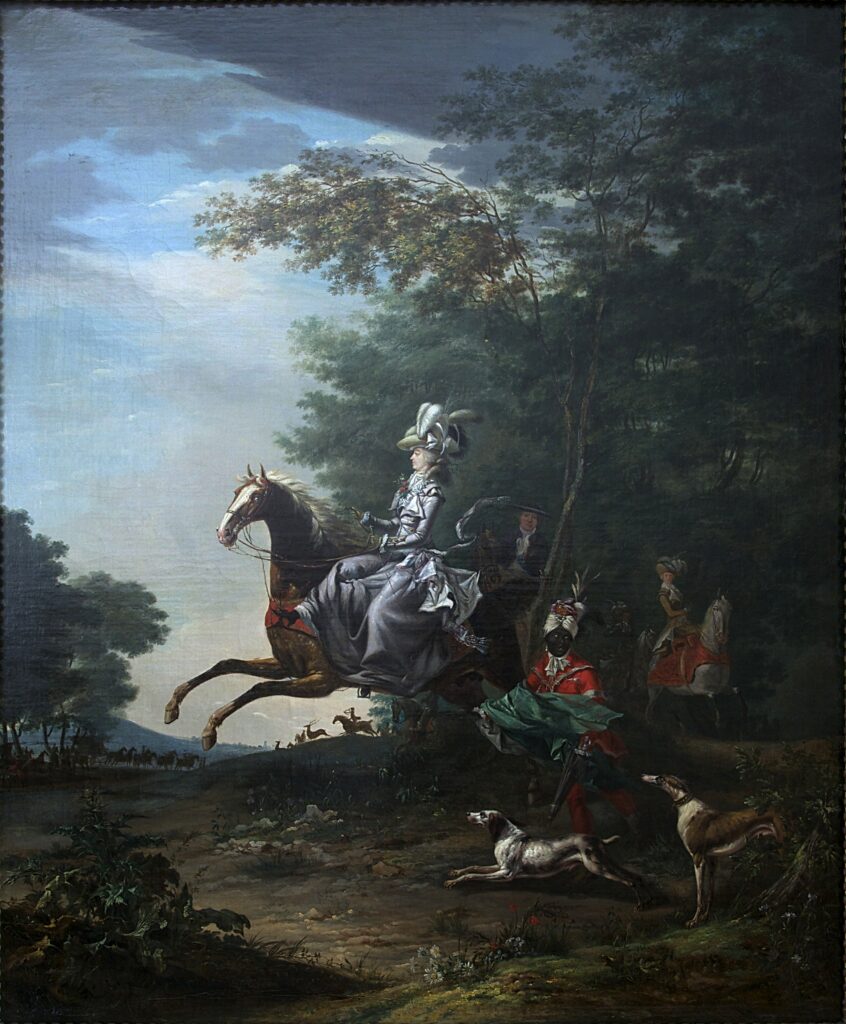
Louis-Auguste Brun’s Marie-Antoinette Hunting, painted in 1783 and used as the exhibition’s lead image, condenses that contradiction. The queen rides confidently through a wooded landscape, with Louis XVI visible behind her. It is an image of movement, privilege and performance, but one made late enough for viewers to know how abruptly that world would end.
By rooting the narrative in rooms the couple actually inhabited, Fontainebleau offers something a conventional gallery cannot. Visitors move between objects and their architectural afterlife, encountering the monarchy not only through famous faces, but through the intimate machinery of residence: where people dressed, entertained, listened and withdrew. The result is a portrait of power at its most cultivated—and most fragile.
Featured image: Louis-Auguste Brun, Marie-Antoinette hunting, 1783. Musée national du Château de Versailles. Faithful reproduction of a public-domain work, Public Domain Mark 1.0, via Wikimedia Commons. The painting is used as the exhibition’s lead image.
