

The National Gallery opened Renoir and Love in London on 3 October, bringing together a concentrated account of how Pierre-Auguste Renoir turned affection, friendship and sociability into subjects of modern painting. The exhibition follows the artist from the mid-1860s to the mid-1880s, the period in which he moved between the immediacy of Impressionism and a more constructed, sculptural approach.
Love as a public language
Rather than treating love as a private anecdote, the exhibition follows it through cafés, theatres, gardens, dance halls and riverside restaurants. Couples exchange glances, friends share tables and families occupy newly public spaces. These scenes made emotion visible within the changing social life of nineteenth-century Paris.
The National Gallery presents 40 paintings from collections around the world. Its stated focus is not romance alone, but the broader ways people connect: flirtation and desire sit beside friendship, kinship and conviviality. That range gives familiar pictures a social structure. Renoir’s figures do not simply pose; they form temporary communities around movement, conversation and leisure.
A landmark loan from Paris
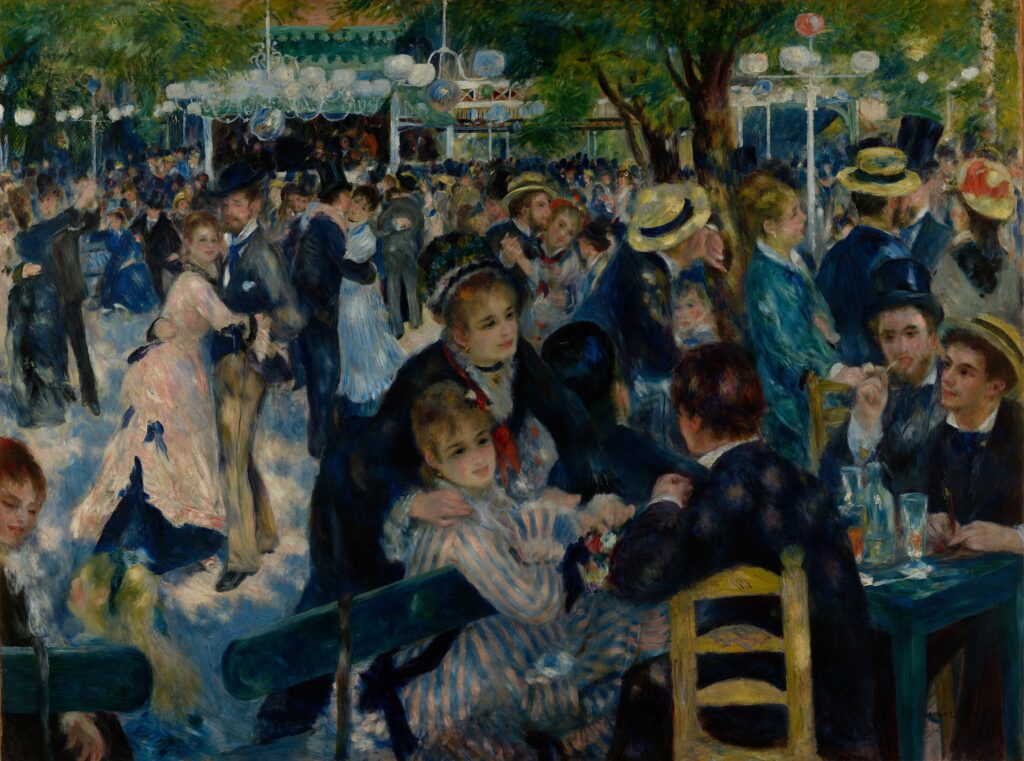
At the centre is Bal du moulin de la Galette (1876), on loan from the Musée d’Orsay and shown in the United Kingdom for the first time. Painted in Montmartre, the canvas disperses attention across dancers and seated groups under shifting outdoor light. Its scale gives working-class recreation the ambition of history painting while preserving the sensation of an unstable crowd.
The official exhibition announcement describes the work as one of Renoir’s most experimental and admired canvases. Other loans trace how the artist repeatedly reworked the choreography of encounter, from informal lunches to staged dances and monumental bathers.
Seen together, the works also make Renoir’s stylistic shifts legible. A tense self-portrait complicates the idea of effortless charm, while The Great Bathers turns fleeting light into weighty, sculptural bodies. Between them, river scenes and restaurant tables show an artist repeatedly testing how spontaneity could be carefully constructed.
A reputation under examination
The exhibition also arrives amid renewed argument about Renoir. His warmth and beauty have often been dismissed as sentimental, while his representations of women remain contested. A review published by the Financial Times on opening day argues that the show restores attention to his doubt, experimentation and uneven development rather than presenting effortless charm.
That tension gives Renoir and Love its critical edge. The paintings ask whether pleasure can carry formal ambition and whether scenes of connection can also expose class, gender and performance. The Guardian selected it as the exhibition of the week, highlighting the coexistence of radiance and raw observation.
Organised with the Musée d’Orsay and the Museum of Fine Arts, Boston, the London presentation runs until 31 January 2027 before travelling to Boston. Its strongest claim is not that Renoir offers uncomplicated happiness, but that sociability itself became a serious modern subject.
Featured image: Pierre-Auguste Renoir, Bal du moulin de la Galette, 1876, Musée d’Orsay, Paris. Faithful reproduction of a public-domain work, Public Domain Mark 1.0.
