




In its quest to curb waste, Brussels may have inadvertently constructed a formidable administrative wall. From 12 August 2026, the Single Market faces a paradox: a harmonised environmental goal enforced through national compliance systems that risk making occasional cross-border sales economically irrational for Europe’s smallest businesses.
Article updated on 23 September 2026.
EDITOR’S NOTE
This article concerns Regulation (EU) 2025/40 on packaging and packaging waste, known as the PPWR. The regulation has applied since 12 August 2026, but national implementation remains uneven and practical compliance routes are still evolving. A Commission proposal to suspend the mandatory authorised-representative requirement for certain EU-established producers remains formally pending in the European Parliament. The Council discontinued negotiations on the EPR suspension proposals on 24 June 2026 because of strong reservations from a vast majority of Member States. As of 23 September 2026, no suspension is in force and Article 45(3) remains applicable. The European Parliament currently lists 19 October 2026 as the indicative first-reading plenary date. This article is intended as a practical information resource, not legal advice, and will continue to be updated as official guidance and national implementation evolve.
More than a month after the PPWR began to apply, the regulatory problem described in this article is no longer purely theoretical.
Etsy has published dedicated guidance for sellers, explaining that qualifying businesses may need to register in national producer registers, appoint authorised representatives, report packaging quantities and provide EPR registration numbers to the platform. Etsy currently collects packaging EPR numbers for France, Germany and Spain, with further countries expected to follow as national systems develop.
eBay has also integrated packaging EPR compliance into seller accounts and warns business sellers that listings may be hidden from buyers in countries where a required packaging registration number is missing or invalid.
Bandcamp has published a dedicated PPWR guide for artists and labels selling physical music and merchandise. It notes that there is currently no single EU-wide registration portal equivalent to the VAT IOSS system and that registration remains country-by-country.
At the same time, some independent artists and small labels have already restricted physical sales inside the EU because of the administrative burden. The regulatory barrier described below is therefore beginning to translate into real commercial decisions.
1. GREEN AMBITION, RED TAPE: THE FRAGMENTATION OF THE SINGLE MARKET
1. GREEN AMBITION, RED TAPE: THE FRAGMENTATION OF THE SINGLE MARKET
The EU’s Packaging and Packaging Waste Regulation (PPWR) aims to curb the continent’s mounting waste. Yet, a paradox emerges: while environmental goals are European, enforcement remains shackled to national bureaucracy. The reform, intended to unify the Single Market, risks fragmenting it further.
The structural friction lies in Extended Producer Responsibility (EPR). Cross-border sellers who qualify as producers under Article 3(1)(15)(c) or (d) can face separate national registration and compliance routes in each destination Member State concerned. Under Article 45(3), they must also appoint an authorised representative for EPR in each such Member State other than the one where they are established. For multinational firms, this is a manageable compliance function; for an independent creator shipping low volumes, it can become an administrative wall.
This creates a fundamental mismatch: the polluter-pays principle loses its proportionality when fixed compliance costs—such as hiring foreign representatives—outweigh the value of the sale itself. Decades of EU integration removed physical borders, but the PPWR inadvertently restores them, replacing the customs officer with a compliance representative. If waste management is a shared European challenge, the solution cannot be to stifle micro-trade through duplicated national procedures.
2. THE COST OF CREATIVITY: AN ARTIST’S GUIDE TO ADMINISTRATIVE BORDERS
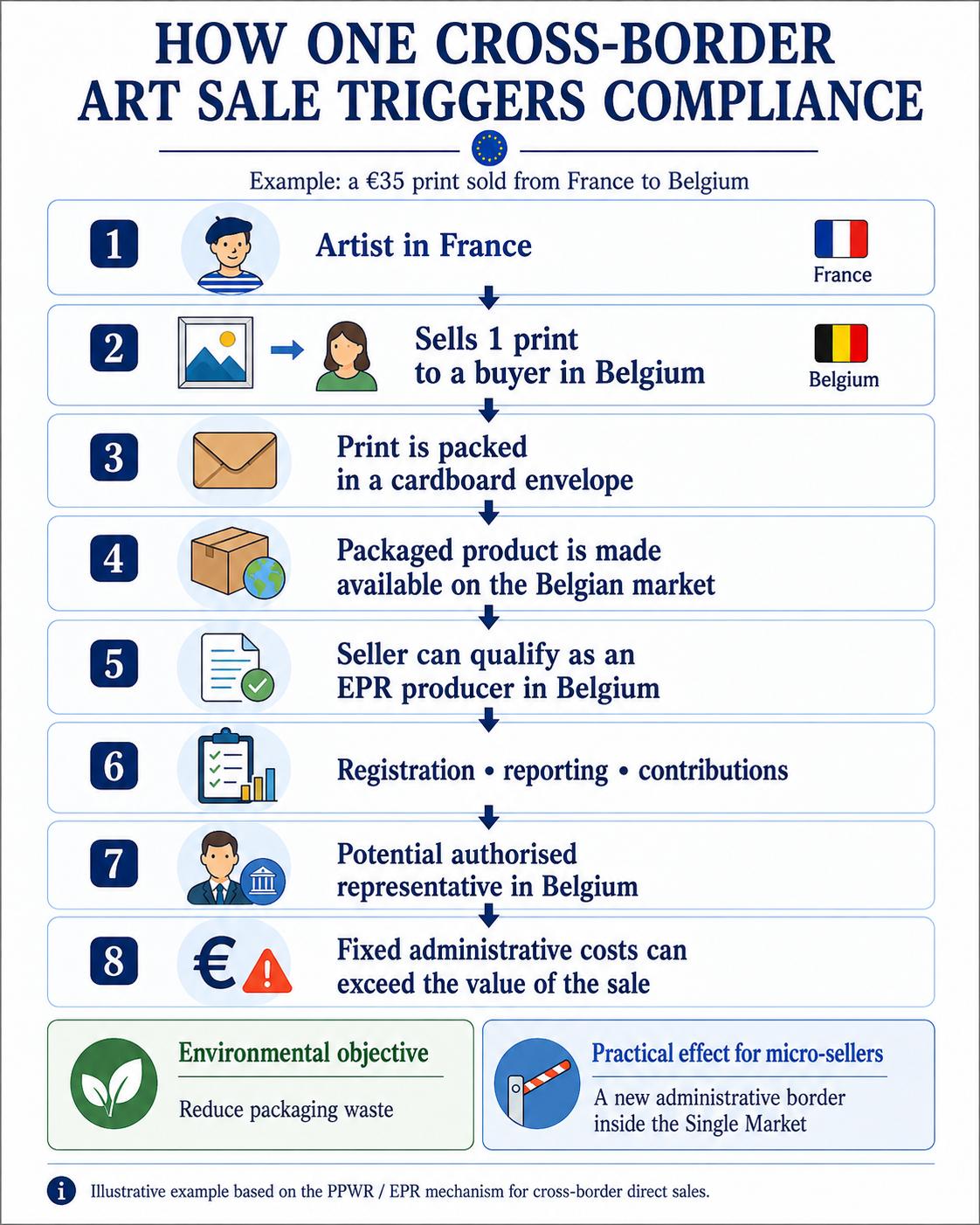
Take the case of a Parisian illustrator selling a €35 print to a collector in Brussels. Online, the transaction is instantaneous. Physically, the artwork travels in a standard cardboard envelope. Legally, however, the PPWR shifts the regulatory weight from the creative content to the physical protection surrounding it.
Commission guidance from 2026 clarifies that an online offering constitutes “making available” a product in the Member State of the end user. This legal trigger bypasses traditional customs events, focusing instead on the seller’s role in placing packaging on a specific national market. This distinction can pull even very small independent creators into the EPR system of a customer’s Member State and, across several destinations, create multiple national compliance relationships.
The regulation’s definition of a “producer” can capture an operator established in one Member State that makes a packaged product available for the first time directly to an end user in another Member State, provided the operator meets the relevant conditions in Article 3(1)(15). Official guidance also confirms that business size does not remove the underlying producer analysis. Consequently, a handful of scattered European sales can create several separate national compliance relationships.
In the Brussels example, the French artist can therefore become a “producer” for Belgian EPR purposes. Despite the low transaction value, that can place the artist within the Belgian EPR system, involving registration, reporting, financial contributions and, under the current wording of Article 45(3), the appointment of a locally established authorised representative for EPR.
The proportionality gap widens as an artist’s reach grows. One sale each in Belgium, Germany, Spain and Austria can therefore mean navigating four distinct national environments. Independent art markets thrive on these scattered, occasional transactions. When fixed administrative costs meet small-scale creativity, the regulatory landscape risks making cross-border art economically unviable.
3. THE UNINTENDED TARGETS: WHY CREATORS ARE AT RISK
Regulation (EU) 2025/40 is no longer a distant legislative prospect. The PPWR generally applies from 12 August 2026, bringing its new packaging framework into practical operation while some individual obligations remain subject to their own timetables.
The PPWR does not create a special exemption simply because a seller is an independent studio or a very small business. Depending on the supply chain and the conditions in Article 3(1)(15), a creator commercially supplying packaged physical products across borders can qualify as the EPR “producer” in the destination Member State.
This can affect painters, ceramicists, photographers and independent designers alike. Purely digital sales do not place physical packaging on another national market, while genuinely private, non-commercial shipments fall outside the regulation’s commercial “making available” concept. Direct commercial sales to end users in another Member State are particularly relevant because the Commission’s guidance treats the online offering as a making available in the end user’s Member State. Very small volumes do not create a general exemption, although reporting and environmental contributions can differ according to volume and national arrangements.
For artists and independent sellers, four concepts define the new terrain. The “producer” is the operator responsible for packaging at the moment it is first placed on a national market. Extended Producer Responsibility (EPR) mandates that this producer contributes to the cost of waste management. Crucially, Article 45(3) requires cross-border producers covered by Article 3(1)(15)(c) or (d) to appoint an authorised representative for EPR in each destination Member State concerned other than the one where they are established. While Article 44 offers a simplified reporting dataset for those under 10 tonnes, this is a procedural convenience, not an exemption from registration or representative requirements. Implementation remains a patchwork; while the regulation is European, the practical compliance routes vary sharply from one capital to the next.
4. DISSECTING THE COMPLIANCE MACHINE
The mechanism is logical on paper but heavy in practice. A creator who directly supplies a packaged work to an end user in another Member State can become the EPR producer in that jurisdiction when the relevant producer definition is met. Under Article 45(3), that producer must appoint an authorised representative for EPR in the destination Member State concerned. The representative is not an artistic agent or distributor, but a natural or legal person established locally and mandated to fulfil EPR obligations on the producer’s behalf.
From an enforcement standpoint, this ensures accountability. From the perspective of a micro-business, it creates an economic mismatch. The environmental fee itself is often nominal; the true cost lies in the administrative overhead of registration, reporting, and retaining local representatives. When these fixed costs are applied to occasional, low-volume sales, the barrier to entry rises—often higher than the profit margin itself.
5. THE CRISIS OF PROPORTIONALITY
Modern independent art markets operate on fluidity, not regional silos. A photographer’s work might reach collectors in four different countries via social media, with no intent to build a fixed distribution network in any of them.
That consequence is now visible in the market. Several independent artists and small labels have publicly restricted physical shipping within the EU since the PPWR became applicable. German DIY label Magasine says it currently ships vinyl only to Germany and Switzerland, citing the bureaucratic and financial burden of complying separately across EU Member States. Puzzle Records similarly limits physical merchandise sales to Germany and non-EU destinations. Independent artist Annika Jayne states that physical shipping from Germany to other EU Member States is currently paused because of the compliance burden.
These examples do not establish how the regulation should be interpreted in every individual case, and sellers remain responsible for assessing their own legal position. They do, however, demonstrate the behavioural effect that matters economically: some micro-sellers are responding to regulatory uncertainty and fixed compliance costs by shrinking the geographic reach of their businesses.
When fixed administrative costs are imposed on this “scattered” business model, the outcome is predictable: the market becomes restricted. If the cost of maintaining compliance in the Netherlands or Spain outweighs the profit of a single sale, the creator has only one rational choice: stop shipping there. A regulation designed to manage waste risks inadvertently recreating administrative borders inside the Single Market.
6. THE EUROPEAN PARADOX: ONE MARKET, TWENTY-SEVEN SYSTEMS
Article 26 of the Treaty on the Functioning of the European Union enshrines the concept of a market without internal frontiers. Yet, the EPR architecture creates a friction that feels distinctly like a pre-Single Market era.
The irony is not lost on the policy community: the Commission’s 2022 impact assessment explicitly justified EU-level action to end the chaos of 27 divergent national rules. Yet, by requiring country-by-country compliance, the final regulation forces small traders to navigate precisely the fragmented landscape the reform sought to abolish. The issue is not the environmental ambition, which remains valid, but the proportionality of the enforcement mechanism for the smallest market participants.
7. THE LEGISLATIVE PATH
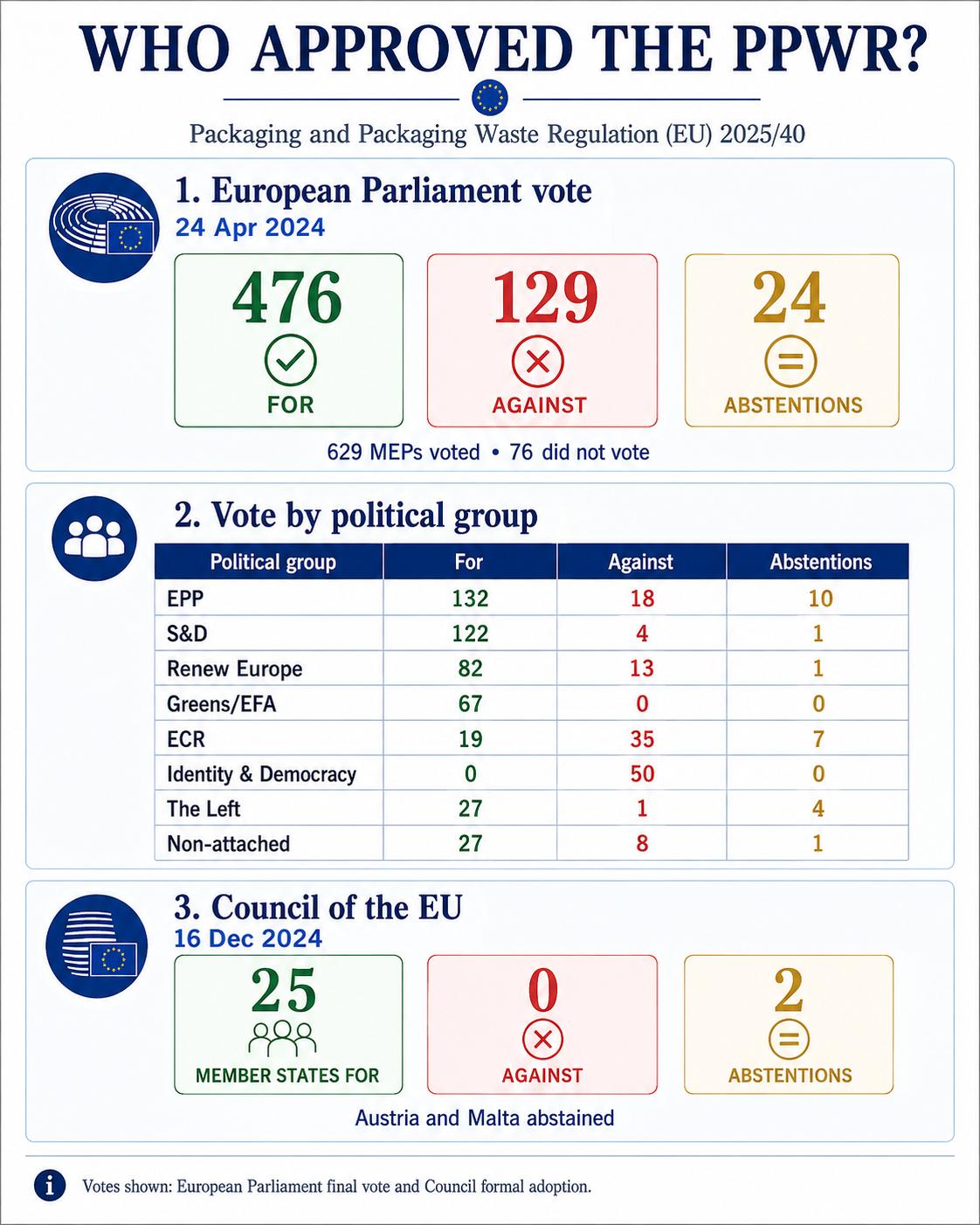
The PPWR’s journey from proposal to regulation was extensive. Launched by the Commission in November 2022, the file was debated, amended, and refined through 2023 and 2024. Parliament approved the text in April 2024, and the Council followed suit in December 2024.
The debate largely centered on high-visibility goals: reducing waste and improving recyclability. The technical machinery of cross-border EPR, the “administrative wall”, remained largely under the radar. The question today is not whether the democratic process failed, but whether the legislative focus on environmental metrics overshadowed the operational reality for the smallest European businesses.
8. WHO PROPOSED, NEGOTIATED AND APPROVED IT?
Democratic accountability lies with the institutions. The European Commission, under the environment portfolio then led by Commissioner Virginijus Sinkevičius, initiated the proposal. The European Parliament, through the ENVI committee and rapporteur Frédérique Ries, steered the negotiations, securing a broad coalition of support across political families, including the EPP, S&D, and Renew Europe.
The Member States, acting within the Council, finalized the approval with overwhelming support. This confirms that the regulation is not an imposition from an abstract “Brussels,” but a consensus-driven policy supported by national governments. The responsibility for addressing the unintended consequences of this policy is now shared by the same institutions that adopted it.
9. A CONTINENT DIVIDED: THE STATE OF PLAY
The legal framework is European, but the practical route to compliance remains national. As checked on 23 September 2026, the Commission’s implementation portal still listed 14 Member States as having notified one or more competent authorities under Article 40(3). This asymmetry creates a compliance fog: in some states, established EPR systems provide relatively clear routes, while in others the available guidance is harder to navigate. The absence of an authority from the Commission list is not an exemption, but the uneven visibility of national procedures illustrates how difficult the system can be for micro-businesses to understand.
Country-by-country implementation snapshot
Status checked: 23 September 2026
Important: “Not listed” means only that no PPWR competent authority was shown on the European Commission implementation portal when this article was checked. It does not mean that packaging EPR obligations do not exist in that Member State, nor does it create an exemption from the PPWR.
Click a country to view its Commission-notification status and a practical note for cross-border sellers.
Austria Notified
Practical note: Verify the Austrian registration, reporting and authorised-representative route for distance sales with the notified authority.
Belgium Notified
Authority: Interregional Packaging Commission (IRPC).
Practical note: Belgium already has a developed packaging EPR framework. Verify registration, reporting, contributions and authorised-representative requirements directly with the competent authority or recognised scheme.
Bulgaria Not listed
No PPWR competent authority was listed by the Commission when checked. This is not an exemption: use the existing national packaging/EPR authorities and request current PPWR guidance.
Official national source: Ministry of Environment and Water – packaging waste.
Croatia Notified
Authority: Ministry of Environmental Protection and Green Transition.
Practical note: Verify registration, reporting, EPR contributions and authorised-representative requirements with the notified ministry.
Cyprus Not listed
No PPWR competent authority was listed by the Commission when checked. This is not an exemption: use the existing national packaging/EPR authorities and request current PPWR guidance.
Official national source: Department of Environment – Extended Producer Responsibility.
Czechia Notified
Authority: Ministry of the Environment of the Czech Republic.
Practical note: Verify the national packaging EPR registration, reporting and authorised-representative requirements with the notified ministry.
Denmark Notified
Authority: Danish Environmental Protection Agency.
Practical note: Verify the applicable registration, reporting and authorised-representative requirements with the notified agency.
Estonia Notified
Authorities: Ministry of Climate, Environmental Board and Environmental Agency.
Practical note: Different authorities handle implementation, market surveillance and reporting; identify the correct route before shipping.
Finland Not listed
No PPWR competent authority was listed by the Commission when checked. This is not an exemption: use the existing national packaging/EPR authorities and request current PPWR guidance.
Official national source: Suomi.fi – producer responsibility in waste management.
France Notified
Authority: Direction générale de la prévention des risques (DGPR) / Ministry for Ecological Transition.
Practical note: Verify the operational French EPR route and producer-responsibility scheme requirements with official sources.
Germany Notified
Competent authorities: The European Commission’s implementation portal refers to a list of German national authorities rather than a single PPWR authority. For packaging EPR and the LUCID Packaging Register, the operational reference point is the Zentrale Stelle Verpackungsregister (ZSVR).
Practical note: ZSVR states that, from 12 August 2026, a company based abroad with no branch in Germany that sells empty packaging or packaged products directly to end users in Germany must appoint an authorised representative. The representative assumes the producer’s EPR obligations except for registration in the LUCID Packaging Register, which remains a personal duty of the producer.
Greece Not listed
No PPWR competent authority was listed by the Commission when checked. This is not an exemption: use the existing national packaging/EPR authorities and request current PPWR guidance.
Official national source: Ministry of Environment and Energy – recycling and producer responsibility.
Hungary Not listed
No PPWR competent authority was listed by the Commission when checked. This is not an exemption: use the existing national packaging/EPR authorities and request current PPWR guidance.
Official national authority: Pest County Government Office – Environmental Protection, Nature Conservation and Waste Management Department.
Ireland Notified
Authorities: Minister for Climate, Energy and the Environment; Environmental Protection Agency; Local Authorities.
Practical note: The Commission specifically assigns the Minister implementation and enforcement roles for Articles 44 and 45, among other provisions.
Italy Not listed
No PPWR competent authority was listed by the Commission when checked. Italy nevertheless has an established national packaging EPR framework. The absence from the Commission list is not an exemption; use official Italian guidance.
Official national source: Ministry of Environment and Energy Security (MASE). The national packaging system also operates through CONAI, a private non-profit consortium established by law.
Latvia Not listed
No PPWR competent authority was listed by the Commission when checked. This is not an exemption: use the existing national packaging/EPR authorities and request current PPWR guidance.
Official national source: State Environmental Service – Extended Producer Responsibility.
Lithuania Notified
Authorities: Environmental Protection Agency, Environmental Protection Department and Ministry of Environment.
Practical note: Several authorities are listed, including a temporary contact point for certain implementation matters. Identify the correct registration and reporting route.
Luxembourg Provisional
Authority: Administration de l’Environnement.
Practical note: The Commission explicitly marks this designation as provisional pending national legislation implementing the PPWR. Check for updates before relying on the current route.
Malta Not listed
No PPWR competent authority was listed by the Commission when checked. This is not an exemption: use the existing national packaging/EPR authorities and request current PPWR guidance.
Official national source: Environment and Resources Authority – packaging producer registration.
Netherlands Notified
Authorities: Human Environment and Transport Inspectorate (ILT) and Rijkswaterstaat.
Practical note: Verify the correct registration, reporting, EPR and authorised-representative route with the competent bodies.
Poland Not listed
No PPWR competent authority was listed by the Commission when checked. This is not an exemption: use the existing national packaging/EPR authorities and request current PPWR guidance.
Official national register: Ministry of Climate and Environment – BDO register.
Portugal Not listed
No PPWR competent authority was listed by the Commission when checked. This is not an exemption: use the existing national packaging/EPR authorities and request current PPWR guidance.
Official national source: Portuguese Environment Agency (APA) – packaging and packaging waste.
Romania Not listed
No PPWR competent authority was listed by the Commission when checked. This is not an exemption: use the existing national packaging/EPR authorities and request current PPWR guidance.
Official national source: Ministry of Environment – Packaging Supervisory Commission.
Slovakia Not listed
No PPWR competent authority was listed by the Commission when checked. This is not an exemption: use the existing national packaging/EPR authorities and request current PPWR guidance.
Official national source: Ministry of Environment – packaging.
Slovenia Notified
Authorities: Ministry of the Environment, Climate and Energy; Slovenian Environment Agency.
Practical note: The Commission states that registration and reporting are carried out by the Slovenian Environment Agency.
Spain Not listed
No PPWR competent authority was listed for Spain on the European Commission implementation portal under Article 40(3) when checked on 13 August 2026. This does not create an exemption. Spain already operates a national packaging producer register, the Registro de Productores de Producto (RPP). MITECO’s interpretative note of 27 July 2026 confirms the Article 45(3) authorised-representative requirement for qualifying direct cross-border sales to Spanish end users.
Official national register: MITECO – Product Producers Register, packaging section. MITECO identifies the Subdirección General de Residuos as the authority responsible for the Spanish register under Article 44. The public list of registered packaging producers was updated on 31 July 2026, and the ministry is developing an automated web service allowing online platforms to check producer registrations.
Sweden Notified
Authority: Swedish Environmental Protection Agency – PPWR guidance.
Practical note: Verify the applicable registration, reporting and authorised-representative requirements with the notified agency.
Source: European Commission, Packaging and Packaging Waste Regulation Implementation, competent national authorities notified under Article 40(3).
10. A CREATOR’S COMPLIANCE ACTION PLAN
A sensible first step is to map the Member States where physical sales actually occur and then determine, for each destination, whether the creator qualifies as the EPR producer. Official government, environmental-agency and Commission sources should be used as the primary reference points rather than relying solely on commercial compliance providers.
Where the national route is unclear, creators should request written guidance from the competent authority and keep basic records of packaging materials, weights, quantities shipped and any registrations or mandates. Sales platforms should also be checked because marketplaces may apply their own compliance-verification procedures.
Creators selling through online platforms should now also check the compliance tools available inside their seller accounts. Etsy currently allows sellers to add packaging EPR registration information for France, Germany and Spain through Shop Manager under Legal and tax information. eBay provides a country-by-country EPR registration interface under Business Info and warns that listings may be hidden in markets where required registration information is missing or invalid. Bandcamp does not currently provide the same registration interface, but advises artists and labels to keep national EPR registration numbers available because it may introduce such a feature in the future.
Platform compliance tools should not be confused with legal compliance itself. Providing a registration number to Etsy or eBay does not replace registration, reporting, scheme participation or authorised-representative obligations where those requirements apply. The platform is increasingly becoming a verification layer, not a substitute for the underlying national system.
Finally, statutory environmental contributions should be distinguished from the commercial price of outsourced compliance services. A private provider’s quote for representation or registration is not the same thing as a fee set by the regulation itself.
11. EXPLORING ALTERNATIVES
Workarounds are limited, but changes to the supply chain can alter who bears EPR responsibility. Local printing, fulfilment services, galleries and distributors may change which operator first makes the packaged product available in the destination Member State, depending on the contractual and commercial structure. None of these options automatically removes EPR obligations, so the objective should be to organise the supply chain clearly rather than redesign a business around a perceived loophole.
12. CALL TO ACTION: BRUSSELS HAS ALREADY IDENTIFIED THE PROBLEM
The European Commission has explicitly acknowledged the structural problem. Its December 2025 proposal to suspend the mandatory authorised-representative requirement for certain EU-established producers cited unnecessary administrative burden, significant cost challenges for SMEs and unintended barriers to the internal market. The proposed correction has still not become law.
On 24 June 2026, the Council discontinued negotiations on the two EPR suspension proposals because of strong reservations from a vast majority of Member States, pointing instead towards a broader review of Extended Producer Responsibility under the forthcoming Circular Economy Act. As of 23 September 2026, procedure 2025/0395(COD) remains formally pending in the European Parliament and is listed as “Awaiting committee decision”. The Parliament’s Legislative Observatory currently gives 19 October 2026 as the indicative first-reading plenary date. Article 45(3) therefore remains applicable and no suspension is currently in force.
The institutional debate has nevertheless moved beyond the question of whether fragmentation exists. The Commission’s Single Market Strategy identifies separate national EPR registrations, reporting requirements and authorised representatives as a real obstacle for SMEs seeking to operate across Europe. It proposes further harmonisation, simplification and digitalisation, including a digital one-stop shop for EPR information, registration and reporting as part of the forthcoming Circular Economy Act.
The path to correction lies in visibilityThe path to correction lies in visibility. Creators must engage national authorities, contact MEPs, and leverage collective platforms. The issue is not just a compliance nuisance; it is a question of whether Europe wants a Single Market that facilitates creativity or one that inadvertently restricts it.
Collective action is the most effective tool. Whether through the petition launched in 2022 to protect micro-businesses or the formal process of petitioning the European Parliament, the message must be consistent: the regulation is well-intentioned, but the mechanism is currently mismatched for the independent creative economy.
Petition: Stop destroying EU micro-businesses: Immediate moratorium on cross-border EPR fees
This petition calls for an immediate moratorium on disproportionate cross-border EPR requirements for micro-businesses, together with an EU-wide de minimis threshold and a genuine European one-stop-shop approach to compliance.
eBay Main Street petition: Protect small businesses and their access to the European Single Market
Launched while the European EPR framework was being reshaped, this eBay Main Street campaign calls for a European one-stop shop for EPR registration and reporting, exemptions and/or a de minimis rule for micro-businesses, and a framework allowing online marketplaces to help small sellers with EPR compliance.
Petition: Protect online sellers from disproportionate PPWR obligations
Original title: “Stoppt die EU-Verpackungsverordnung (PPWR) zum Schutz von Online-Händlern”
This German petition calls for protection of small online sellers from disproportionate consequences of the new EU packaging rules.
Petition: Keep micro-businesses inside the EU Single Market
Original title: “Klein- und Kleinstunternehmen nicht aus dem EU-Binnenmarkt verdrängen!”
Launched in 2022, this petition calls for a de minimis threshold, simpler EPR obligations and a centralised European approach inspired by the One Stop Shop principle.
Official route: Petition the European Parliament
EU citizens and residents, as well as organisations based in the European Union, can submit a petition directly to the European Parliament through its official petitions portal.
13. CONCLUSION: MORE EUROPE, LESS PAPERWORK
The objectives of the PPWR, a cleaner, circular, and sustainable Europe, are correct. The danger lies in the execution. By fragmenting compliance into 27 national silos, the current framework risks marginalizing the very entrepreneurs who define European culture.
Environmental responsibility need not mean administrative paralysis. The solution now being considered at European level closely resembles the model advocated in this article: greater harmonisation, fewer duplicated national procedures and a digital one-stop shop for EPR information, registration and reporting. The Commission has identified such a system as part of the work leading towards the Circular Economy Act.
A genuine European compliance gateway would not eliminate national waste-management responsibilities or environmental contributions. It could, however, allow a micro-business to register and report through one interface while the relevant information is routed to national systems. Combined with proportionate requirements for negligible cross-border volumes, this would preserve environmental accountability without making occasional European sales commercially irrational.
We have the opportunity to refine the mechanism without abandoning the mission.We have the opportunity to refine the mechanism without abandoning the mission. By embracing a truly European, harmonised compliance system, the EU could prove that it is capable of being both environmentally ambitious and administratively intelligent. The Single Market was built to remove borders; it should not be the place where we rebuild them for the artist’s cardboard envelope.
FAQ: PPWR FOR INDEPENDENT CREATORS
Does PPWR apply to independent artists?
It can. An artist, photographer, designer or other independent creator selling packaged physical goods commercially into another EU Member State can qualify as a packaging producer depending on the circumstances defined by the PPWR. There is no general exemption simply because the seller is an artist or micro-business.
Do Etsy sellers need to register for packaging EPR in Europe?
Potentially. Etsy now advises sellers that, depending on where they sell and how they qualify under national rules, they may need to register in national producer registers, report packaging and provide EPR numbers. Etsy currently collects packaging EPR information for France, Germany and Spain.
Can marketplaces restrict listings for packaging EPR non-compliance?
Yes. eBay states that listings may be hidden from buyers in countries where a required packaging registration number is missing or invalid.
Do artists need an authorised representative in every EU country?
Where Article 45(3) applies to a cross-border producer covered by the relevant producer definitions, an authorised representative must currently be appointed in each destination Member State concerned other than the Member State where the producer is established. A proposal to suspend this requirement for certain EU-established producers remains pending and has not entered into force.
Is there a single EU PPWR or EPR registration portal?
Not currently. Registration and reporting remain organised through national systems. The European Commission has, however, announced plans to address EPR fragmentation through greater harmonisation and a digital one-stop shop for information, registration and reporting.
Does PPWR apply to digital art?
A purely digital sale does not place physical packaging on the market. The packaging obligations discussed in this article arise when physical goods or works are commercially supplied using packaging.
Official sources & further reading
Primary law. Regulation (EU) 2025/40 on packaging and packaging waste (PPWR), including Articles 44 and 45 on producer registration and extended producer responsibility.
European Commission overview. Packaging waste: PPWR overview, implementation resources and timeline.
Implementation and national authorities. European Commission PPWR implementation portal, including competent authorities notified by Member States.
Commission guidance. Commission Notice C/2026/3702: Guidance document for Regulation (EU) 2025/40, published in OJ C as C/2026/3084 on 10 June 2026 (CELEX 52026XC03084).
Commission FAQ. Frequently Asked Questions on the PPWR, published by DG Environment on 3 August 2026.
Original Commission proposal. COM(2022) 677, which set out the original case for EU harmonisation and reducing fragmentation of the internal market.
Impact assessment. SWD(2022) 384, the Commission impact assessment accompanying the original proposal.
European Parliament vote. European Parliament, 24 April 2024. The final vote was 476 in favour, 129 against and 24 abstentions.
Political-group voting breakdown. HowTheyVote.eu: Packaging and packaging waste vote, compiled from European Parliament voting data and used for the political-group breakdown shown in the infographic above.
Council adoption and voting record. Council formal adoption, 16 December 2024, together with the official Council voting record: 25 Member States in favour, none against, with Austria and Malta abstaining.
Single Market legal basis. Article 26 TFEU defines the internal market as an area without internal frontiers. Article 34 TFEU prohibits quantitative restrictions on imports and measures having equivalent effect between Member States.
Commission proposal to suspend the authorised-representative rule. COM(2025) 982, proposing to suspend Article 45(3) until 1 January 2035.
Current legislative status. European Parliament Legislative Observatory, procedure 2025/0395(COD): formally pending, currently listed as ‘Awaiting committee decision’; amendments were tabled on 1 July 2026 and 19 October 2026 is shown as an indicative first-reading plenary date. The Council statement of 24 June 2026 records that negotiations on the two EPR suspension proposals were discontinued because of strong reservations from a vast majority of Member States. No suspension is currently in force.
Spain. MITECO – Product Producers Register, packaging section, together with MITECO’s interpretative note of 27 July 2026 and the public producer list updated on 31 July 2026.
Germany. Zentrale Stelle Verpackungsregister (ZSVR) – PPWR authorised-representative guidance.
Single Market Strategy. European Commission, A simple and seamless Single Market, identifying fragmented national EPR schemes and proposing further harmonisation, simplification and a digital one-stop shop for information, registration and reporting.
Etsy seller guidance. New EU Packaging and EPR Rules: What They Mean for Your Shop, 3 September 2026.
eBay seller guidance. EU Packaging and Packaging Waste Regulation, including country-by-country packaging registration numbers and listing-visibility implications.
Bandcamp guidance for creators. Packaging and Packaging Waste Regulation (PPWR) Guide for Artists and Labels, explaining the country-by-country registration structure for physical merchandise.
Industry initiative. eBay Main Street: Protect small businesses and their access to the European Single Market, calling for a European EPR one-stop shop, micro-business exemptions and/or a de minimis rule, and a framework enabling marketplaces to assist sellers with EPR compliance.
Citizen initiatives. The three Change.org petitions referenced above are Stop destroying EU micro-businesses: Immediate moratorium on cross-border EPR fees, Protect online sellers from disproportionate PPWR obligations and Keep micro-businesses inside the EU Single Market. The official route for EU citizens and residents is the European Parliament Petitions Portal.