
Grace Weir has turned a Georgian townhouse in Bath into a contemporary instrument for looking, placing astronomy, domestic life and overlooked labour on the same orbit.
The As-Yet Unseen opened at the Herschel Museum of Astronomy on 5 September. Curated by Bridget de León and running through 3 January 2027, the exhibition threads new works through the former home of William and Caroline Herschel, where observation was inseparable from the rooms, routines and conversations of everyday life. It is the first time the museum has integrated contemporary site-responsive art throughout its historic spaces.
A domestic cosmos
Weir does not treat the house as a neutral container. She uses its dining room, workshop and collections as evidence that scientific knowledge is made somewhere, by people, amid ordinary obligations. In On the Construction of Heavens, William Herschel’s 1785 map of the Milky Way has been embroidered onto an antique linen tablecloth. A diagram of the galaxy therefore returns to the surface around which the siblings may once have discussed its shape.
Downstairs, an LED counter measures the changing distance between Earth and Uranus, the planet William identified from the garden in 1781. Elsewhere, the installation combines paintings of prisms, cyanotypes made from shadows in the house and a drawing scattered with minerals described as stardust. The works are dispersed rather than announced, asking visitors to search and linger. As Weir told The Guardian, the Herschels practised a form of patient attention that sits uneasily beside the speed of scrolling.
Caroline Herschel comes into focus
The exhibition also adjusts the balance of a familiar story. Caroline arrived in Bath initially as her brother’s housekeeper, then became an essential collaborator: recording observations, making calculations and maintaining instruments before discovering eight comets herself. She became the first woman in England to receive a salary for work in astronomy.
Weir’s An Imperfect Account brings that history into material form through a meteorite fragment and a piece of obsidian shaped like one of Caroline’s worry beads. The pairing makes cosmic matter intimate, while refusing to separate intellectual achievement from the repetitive, often invisible work that sustained it.
The show appears alongside Photology: John Herschel, Henry Talbot and Early Photography, an exhibition on William’s son and the development of photographic processes. The museum’s current programme links astronomy and photography through light, experiment and recording, while Weir adds another question: who gets recognised when discovery is reconstructed as history? An Art Fund listing and a detailed notice from British Photographic History confirm the dates and range of works.
By embedding art in the Herschels’ former home, Weir avoids illustrating science from a distance. Instead, she makes looking itself the subject. The result is a quiet intervention with a large proposition: knowledge advances not only through spectacular breakthroughs, but through collaboration, sustained attention and the rooms in which ideas are patiently worked out.
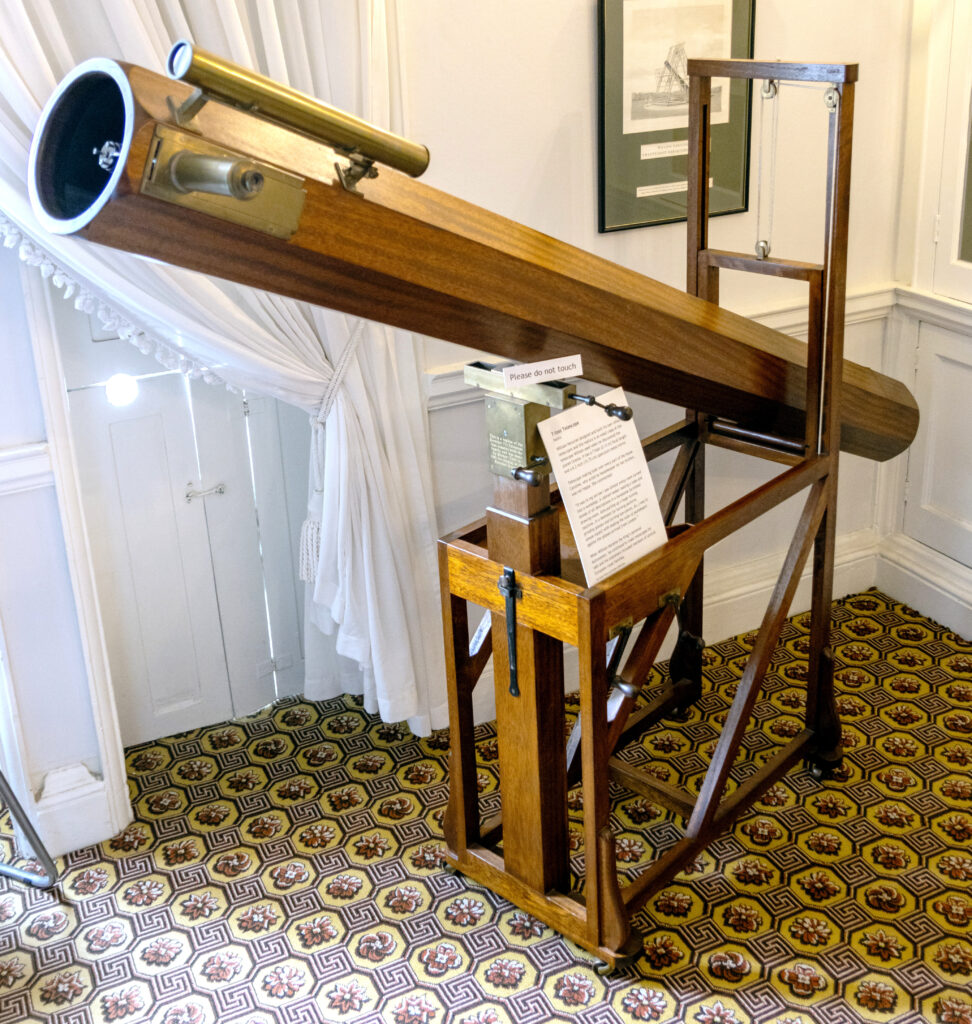
Featured image: contextual photograph of the Herschel Museum’s 1981 replica of William Herschel’s seven-foot telescope, photographed in 2023. This image does not show Grace Weir’s 2026 exhibition. Photo: Mike Peel / Wikimedia Commons. CC BY-SA 4.0. No editorial modification; WordPress applied automatic resizing.
