
Ottawa’s national showcase brings six regional practices into one conversation before the November decision, with land, language, memory and materials shaping the encounter.
Ottawa’s National Gallery of Canada opened the 2026 Sobey Art Award exhibition to the public on 4 September, bringing six regional practices into one room before the winner is announced in November. The display turns a national competition into a close look at how artists work with land, language, memory and materials.
The shortlist reaches across the country. Melaw Nakehk’o represents the Circumpolar region, Samuel Roy-Bois the Pacific, Audie Murray the Prairies, Lotus L. Kang Ontario, Caroline Monnet Quebec and Shane Perley-Dutcher the Atlantic region. Together, they move through sculpture, installation, photography, painting, film, textiles and metalwork, making the exhibition less a survey of one style than a map of distinct artistic positions.
Materials carry place and memory
Material choices carry much of that range. Nakehk’o’s soft sculpture Mostly Human uses caribou hide she tanned herself, placing Dene knowledge and land-based practice at the centre of the work. Roy-Bois examines how built spaces and ordinary objects shape human experience. Murray’s To Make Smoke turns charcoal from burned sweetgrass, cedar and sage, mixed with locally sourced water, into a wall drawing that records labour, ceremony and presence.
Kang’s kinetic Azaleas II takes the form of a tool once used to dry processed 35-mm film. Its movement follows a score based on the metre of poems by Kim Sowŏl and Kim Hyesoon, joining photographic memory to time and repetition. Monnet uses materials associated with construction, including polyethylene and cement, to address Indigenous experience, housing and language. Perley-Dutcher, a Wolastoqey metalsmith and basket maker, reworks ash-splint basket traditions in sculptural forms that connect technical training with inherited knowledge.
Those connections emerge from the Gallery’s account of the installed works, rather than from a single curatorial theme imposed on every finalist. A complimentary publication on the six artists is also available to visitors, extending the comparison beyond the galleries.
Six practices before one decision
That attention to process matters because the Sobey is not only a prize ceremony. The exhibition lets visitors compare work selected through six geographic regions without flattening the artists into representatives of place. An installation view published by the Gallery and dated 4 September confirms that the exhibition is in place, while the accompanying profile of Murray stresses the relationships among materials, territory and community within her practice.
The award, created in 2002 and jointly administered by the National Gallery and the Sobey Art Foundation since 2016, directs substantial financial support toward contemporary artists. This year’s winner will receive C$100,000 on 14 November. Each of the other five shortlisted artists receives C$25,000, while every longlisted artist receives C$10,000. The regional jury structure is part of how the award builds that national field.
For audiences, the interval before the decision is useful. It keeps the focus on six bodies of work rather than a single name, and it makes regional breadth visible through concrete differences in method. The 2026 Sobey Art Award exhibition remains on view in the National Gallery’s Contemporary Galleries in Ottawa until 3 January 2027.
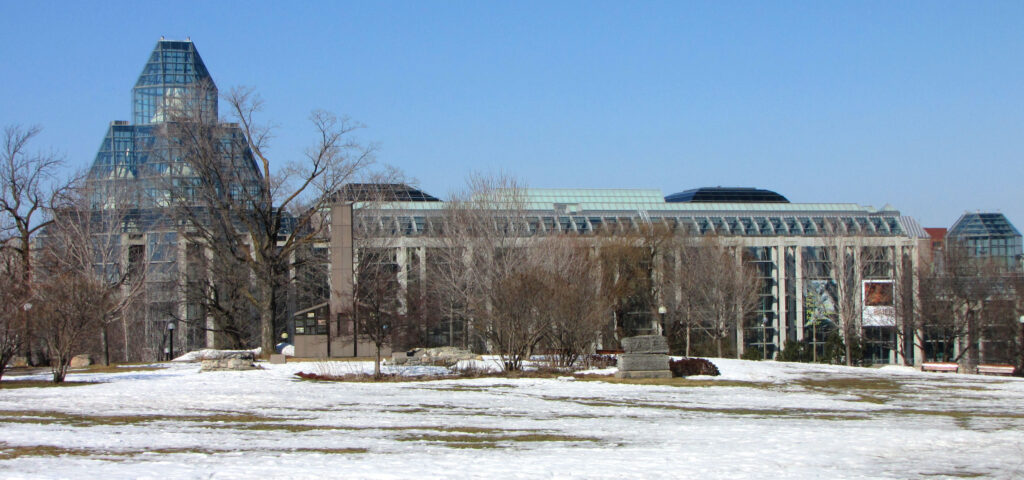
Featured image: National Gallery of Canada in Ottawa, photographed on 7 March 2010. Historical contextual view, not a photograph of the 2026 Sobey Art Award exhibition, its works, artists or opening. Photo: D. Gordon E. Robertson, “National Gallery of Canada.jpg”, CC BY-SA 3.0. No editorial crop or retouching; automatic WordPress resizing.
