
Gabriel Orozco’s Chronotopic opened at White Cube Bermondsey in London on 16 September, turning nearly 200 works into a restless map of time and place. Curated by art historian Briony Fer, the exhibition moves across sculpture, painting, photography, assemblage and works on paper, asking how objects change as they travel between sites, histories and systems of interpretation.
The scale is retrospective, but the structure is deliberately unstable. White Cube describes the exhibition as a “chrono-nautical log”: less a linear career survey than a sequence of zones in which everyday materials, formal games and archaeological echoes meet. Current installation views published by the gallery confirm that the exhibition is now open, following a public preview and conversation between Orozco and Fer on 15 September.
Objects that refuse to stay still
Orozco has spent more than three decades testing how small interventions can disturb familiar ways of seeing. In Chronotopic, disposable materials such as tissue and toilet paper sit beside tempera, gold leaf and carefully altered objects. The contrast matters: fragile things can carry long histories, while apparently monumental forms may begin with a joke, a found object or a rule borrowed from a game.
Among the exhibition’s anchors is La DS (Cornaline) (2013), Orozco’s narrowed Citroën, displayed with works rarely seen in the United Kingdom, including The Weight of the Sun (2003), Visible Labor (2015) and Lluvia de Aplausos (2025). New pieces from 2026 extend his recurring vocabulary of circles, grids, orbital movement and chance encounters.
The result is not a chronology with a tidy beginning and end. Fer instead treats time as cyclical and mobile. Works loop back to earlier motifs, then acquire different meanings through their neighbours. A car can read as sculpture, design history or spacecraft; a sheet of paper can become both record and material event. The exhibition’s title joins chronos, time, to topos, place, making that movement its organizing principle.
A London return built across decades
The opening also marks several intertwined histories. It arrives 20 years after Orozco’s first White Cube exhibition, 30 years after his solo presentation at London’s Institute of Contemporary Arts, and a decade after the permanent Orozco Garden opened at South London Gallery. Rather than frame those anniversaries as milestones, Chronotopic uses them as coordinates in a practice shaped by movement between Mexico, Europe, the United States and Asia.
The Guardian placed the show among the week’s cultural highlights, while Ocula and the IFPDA list it as currently on view. At White Cube, that external confirmation meets the evidence of the galleries themselves: an exhibition already assembled as a field of objects that refuse to remain fixed in one time or meaning. That refusal is the point: movement is not background to the work but one of the materials from which it is made.
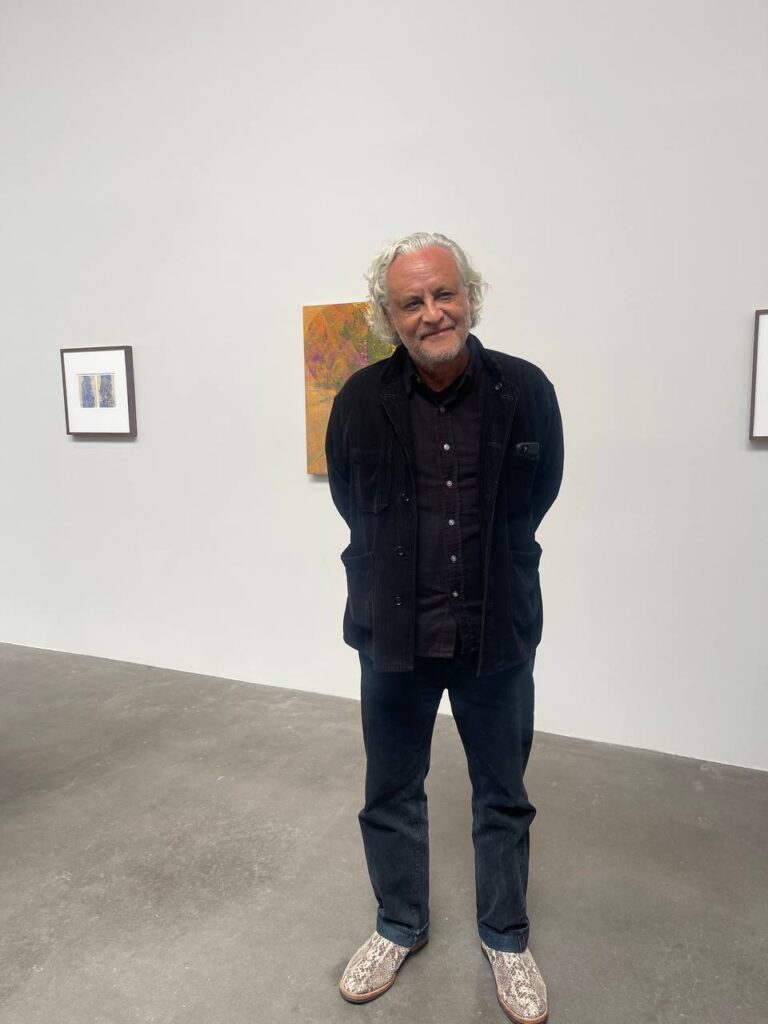
Image credit: Gabriel Orozco at Kurimanzutto, Mexico City, 10 February 2024. Photograph by TSolange, via Wikimedia Commons, licensed under CC BY-SA 4.0. Contextual portrait; the image does not show Chronotopic or its 2026 installation. No editorial changes; WordPress may generate resized derivatives.
