

Florence’s Palazzo Strozzi opened Broken: The Power of the Fragment on 25 September, bringing more than 80 sculptures and artefacts into a conversation about damage, survival and the meanings that incomplete objects acquire over time. Spanning roughly five millennia and five continents, the exhibition treats the fragment not as a failed whole, but as an object with a history of its own.
Organised with the National Gallery of Art in Washington, the show moves from ancient Egypt, Greece and Rome to premodern cultures in Mexico, Mali, Peru and Cambodia, then into modern and contemporary practice. Its premise is unusually direct: breakage can record iconoclasm, warfare, natural disaster, excavation or deliberate artistic choice. What is missing can be as informative as what remains.
Bodies shaped by what happened to them
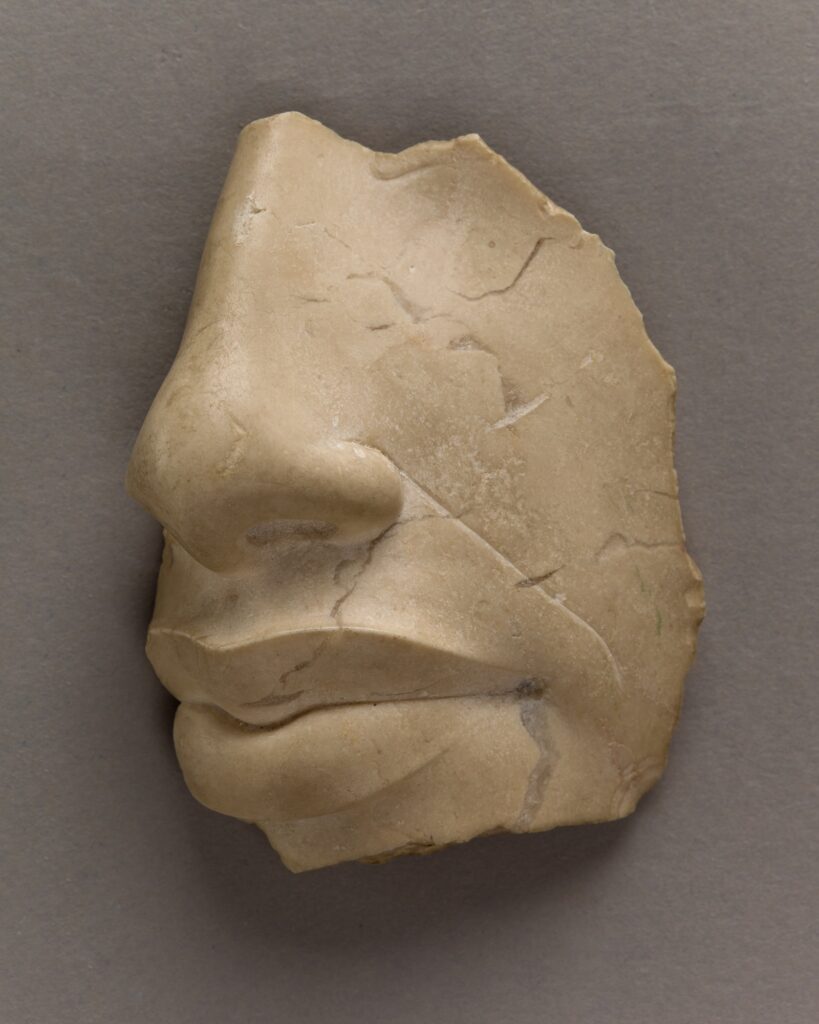
The exhibition opens with faces and bodies whose absences intensify their presence. A small limestone fragment preserving the nose and lips of the pharaoh Akhenaten, made around 1347–1330 BCE and lent by the Metropolitan Museum of Art, has become the show’s emblem. Nearby, fragments from Giovanni Pisano’s funerary monument to Margaret of Brabant and a colossal damaged head of the Buddha extend the question across cultures and scales.
Later galleries shift from accident to political violence. Adolfo Wildt’s monumental Dux, a 1923 bust of Benito Mussolini, still carries holes made by pickaxes after Italy’s Liberation. A seated figure from Guzana, shattered during a Second World War bombing raid in Berlin and reconstructed from some 27,000 pieces, makes restoration itself visible. The repaired surface does not erase catastrophe; it gives the object a second biography.
Florence supplies another form of rupture. A restored Christ Carrying the Cross from the Museo di San Marco retains sediment left by the city’s devastating 1966 flood. Presented as the disaster’s sixtieth anniversary approaches, it connects conservation to climate, memory and the vulnerability of cultural heritage.
Absence as evidence
Broken also asks when fragmentation becomes an artistic language rather than damage. Works by Michelangelo, Auguste Rodin and Alberto Giacometti lead toward contemporary artists including Louise Bourgeois, Huma Bhabha, Robert Gober, Francesco Vezzoli and Danh Vo. Their partial bodies and displaced objects show how artists can use incompleteness to resist fixed meanings.
The final rooms broaden that idea through scale and juxtaposition. A monumental raised finger associated with Constantine faces Julius von Bismarck’s Elephant in the Room, while Mark Manders has created a new installation for Palazzo Strozzi’s Renaissance courtyard. Across these encounters, the fragment acts less like a remnant awaiting repair than a tool for looking: it exposes histories of ownership, destruction, movement and display.
The exhibition’s strength lies in making damage legible without reducing every object to trauma. A missing face may signal violence, but it can also activate imagination; a reconstructed sculpture can embody both loss and care. Broken proposes that survival is not the restoration of an untouched past. It is the capacity of an altered object to continue asking questions in the present.
Image: Nose and lips of Akhenaten, ca. 1347–1330 BCE, indurated limestone, The Metropolitan Museum of Art, object 26.7.1395. The work is included in Broken. Photograph supplied through The Met Open Access programme, CC0 1.0.
