

On 2 October, the Royal Academy of Arts opened Painting the French Riviera, a survey of how one coastline helped redirect modern art. More than 120 works trace artists’ encounters with the Mediterranean from the 1870s to the 1960s, when the region shifted from a place of experiment into an international image of leisure and glamour.
A coastline becomes a laboratory
The exhibition, co-organised with the Cleveland Museum of Art, begins before the Riviera was a settled cultural brand. Cézanne, Renoir and Morisot found in southern France a light that sharpened colour and simplified form. Monet’s visits to Bordighera, Cap Martin and Antibes then tested how quickly paint could register sea, sky and vegetation without losing their intensity.
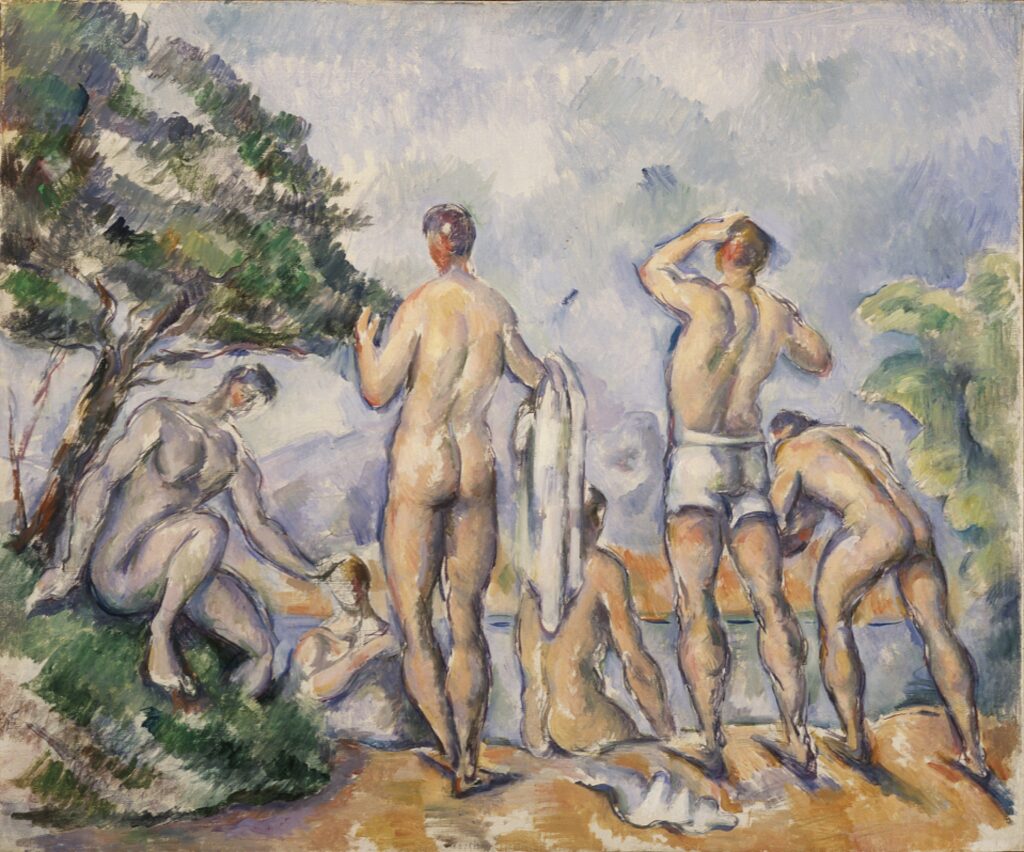
Paul Cézanne’s Bathers of 1890–92 gives that first section its harder edge. Five male figures gather beside water beneath a compressed blue sky. Their bodies and the Provençal landscape appear built from the same planes, turning the memory of swimming near Aix-en-Provence into an early argument for the geometry that would shape twentieth-century painting.
The route continues through the Neo-Impressionists. Paul Signac and Henri-Edmond Cross separated Mediterranean colour into disciplined touches, making radiance a method rather than an atmospheric effect. The Riviera was becoming both subject and workshop: a place where artists could revise the visual rules they had brought from northern cities.
From colour revolution to mass image
That experiment accelerated when Henri Matisse and André Derain worked at Collioure in 1905. Their heightened reds, yellows and blues detached colour from description and helped define Fauvism. Later rooms follow Matisse’s interiors, Picasso’s mythic and bodily responses to the coast, and the region’s movement into sculpture, ceramics and design.
The exhibition also asks what happened when modern art helped manufacture the Riviera’s public image. Travel posters, fashion and film transformed a working coastline into a promise of sun, speed and escape. By the 1950s and 1960s, that promise could be repeated almost endlessly. Yves Klein’s saturated blue works close the story by reducing sea and sky to an idea that feels both local and limitless.
A seductive story with visible gaps
The display has already produced sharply different critical readings. The Arts Desk sees delight in the exhibition’s range, while The Guardian argues that its geography overwhelms the rivalry and erotic charge of Matisse and Picasso. The Financial Times instead stresses how Mediterranean light connects Cézanne’s structure, Fauvist colour and later modernisms.
Those disagreements make the exhibition more useful. Rather than presenting the Riviera as a seamless paradise, they expose the tension between a real landscape, an artistic laboratory and a marketable dream. The Royal Academy’s show succeeds most when those three versions of the coast occupy the same frame.
Painting the French Riviera runs at the Royal Academy of Arts in London through 31 January 2027.
Image credit: Paul Cézanne, Bathers, 1890–92, oil on canvas, Saint Louis Art Museum. Faithful reproduction of a public-domain work, Public Domain Mark 1.0, via Wikimedia Commons. The painting is included in the exhibition.
