

On Sunday, October 18, Sarasota Art Museum opened Presence: The Photography Collection of Judy Glickman Lauder, bringing a century of photographic encounters to Florida’s Gulf Coast. The exhibition gathers more than 100 photographs by over 50 artists, moving from intimate portraiture and city life to labor, landscape, war and public struggle. Rather than arranging photography as a parade of famous names, it asks how an image can certify that a person, place or moment existed.
A collection organized by human experience
Co-organized by the American Federation of Arts and the Portland Museum of Art in Maine, Presence is curated by Anjuli Lebowitz. The Sarasota presentation places Diane Arbus, Richard Avedon, Danny Lyon, Gordon Parks and James Van Der Zee within a collection shaped by Judy Glickman Lauder’s own practice as a photographer and humanitarian. The museum describes the exhibition as a dialogue across distinct forms of attention: tenderness, wonder, hardship, cruelty, justice and joy.
That approach matters because Lauder assembled the collection over decades through personal response rather than an encyclopedic checklist. An independent account of the touring exhibition points to encounters such as Dorothea Lange’s Migrant Mother, Parks’s American Gothic, James Karales’s photographs of the Selma-to-Montgomery march and Todd Webb’s panoramic study of Sixth Avenue. Historical distance collapses when works are grouped by emotional or ethical resonance instead of chronology.
Photography as evidence and encounter
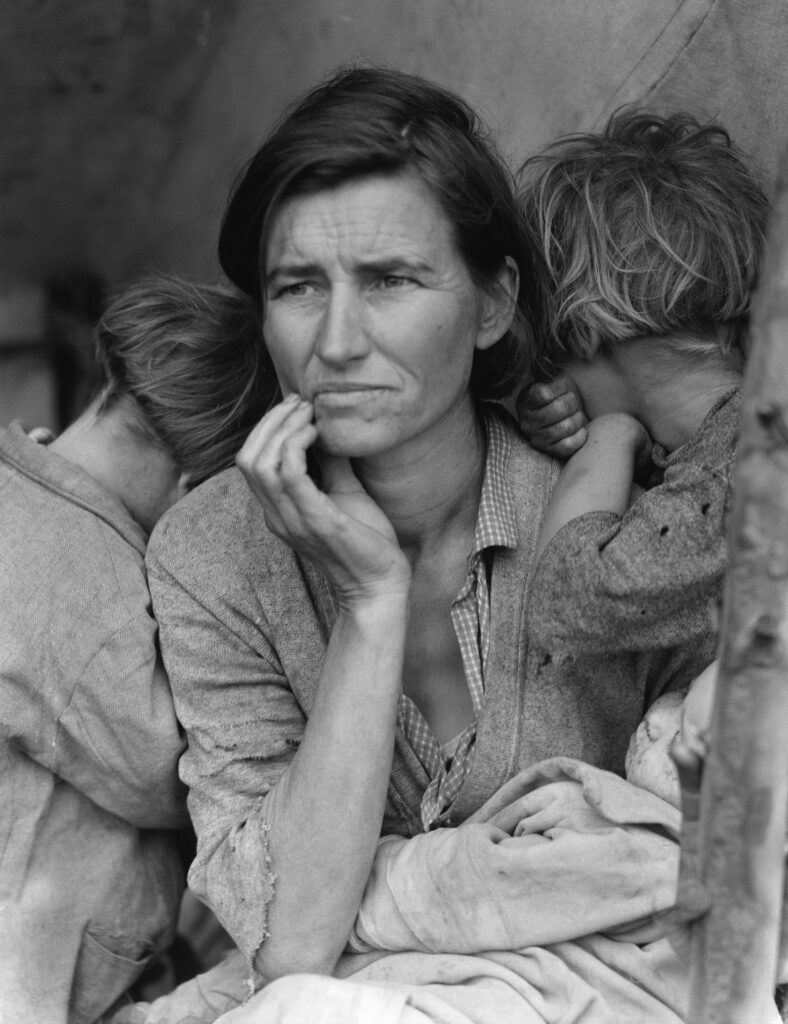
Lange’s 1936 Migrant Mother crystallizes the exhibition’s central question. Made while she worked for the U.S. Farm Security Administration, the photograph records Florence Owens Thompson with her children at a camp for pea pickers in Nipomo, California. Its extraordinary afterlife has made it an emblem of the Great Depression, yet its power begins with a specific encounter between photographer, subject and circumstance. In Presence, that image sits inside a broader argument: photographs are not neutral records, but acts of looking that continue to shape how history is remembered.
The exhibition also tests what happens when canonical images share space with less familiar work. A private collection becomes a public sequence, and recognition gives way to comparison. Visitors can follow recurring gestures, glances and social tensions across decades, seeing how different photographers used the camera to witness both ordinary life and historical pressure.
Sarasota is the second stop on a four-venue American tour, following the Southampton Arts Center in New York. The Sarasota installation opened to members on October 17, with public admission starting the following day and a curator’s tour scheduled for October 19. After closing in Florida on April 4, 2027, the exhibition will travel to the Gibbes Museum of Art in Charleston and the Lowe Art Museum in Miami. Its movement between institutions extends Lauder’s original act of collecting into a shared civic experience: images once gathered privately are made available for renewed, collective looking.
Image: Dorothea Lange, Migrant Mother, 1936. Farm Security Administration / Library of Congress, Prints & Photographs Division. The Library of Congress states that there are no known restrictions on use of the Migrant Mother images and that the FSA/OWI black-and-white collection is in the public domain and free to use and reuse.