

At the Morgan Library & Museum in New York, a lion is more than an animal study. Rembrandt’s Lions: Art and Exile in the Dutch Republic, which opened to the public on October 23, gathers drawings, etchings and paintings to examine how migration shaped both seventeenth-century Amsterdam and the artist who came to embody it.
The exhibition begins with a useful contradiction. Rembrandt van Rijn is now treated as quintessentially Dutch, yet the country, its identity and its borders were still taking form during his lifetime. Amsterdam was a city of arrivals: according to the exhibition’s curatorial account published by CODART, as many as 60 percent of its residents had been born elsewhere. Religious refugees, merchants, laborers and artists remade the city, although the freedoms advertised by the Dutch Republic were never shared equally, especially across its colonial territories.
A republic built by arrivals
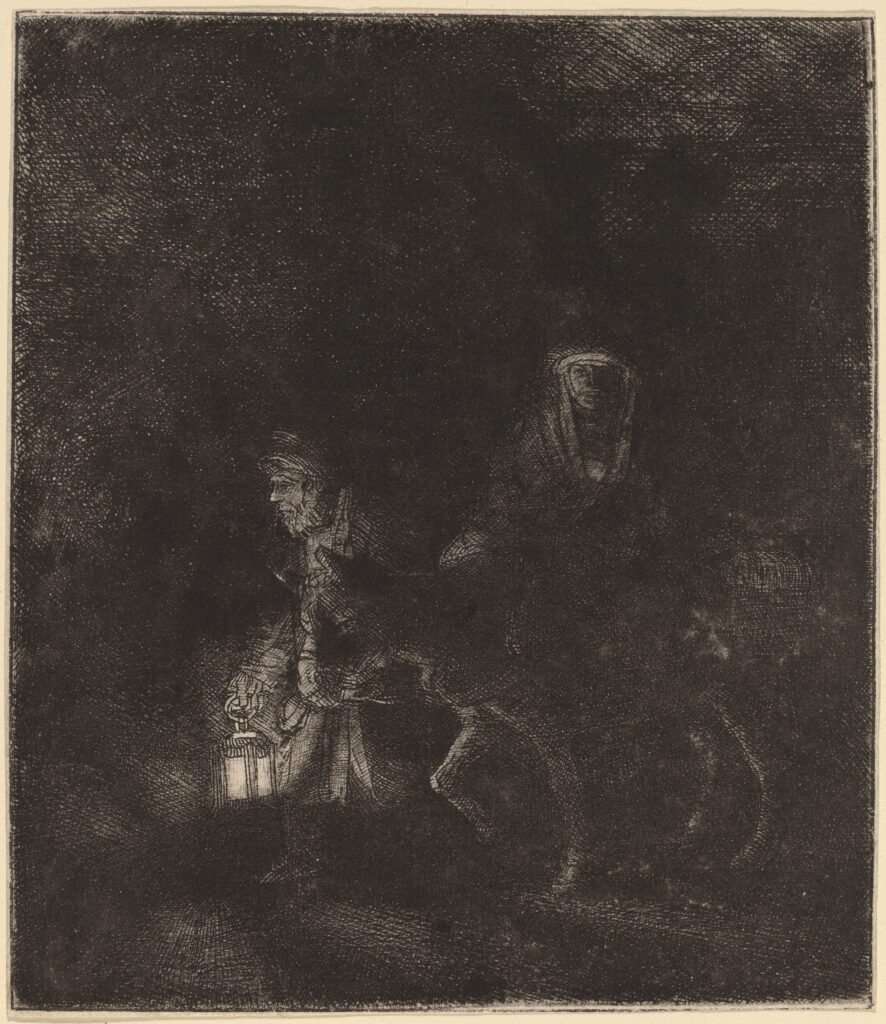
That context shifts the way Rembrandt’s familiar faces are seen. His portraits and street observations become records of a mixed urban population rather than illustrations of a sealed national culture. Biblical subjects of flight and refuge enter the same field. In The Flight into Egypt: A Night Piece (1651), a small pool of lantern light gathers a family moving through darkness; displacement becomes immediate, fragile and physical.
The Morgan’s holdings anchor the presentation. Its collection includes the largest group of Rembrandt etchings in North America, and loans extend the argument across media. Apollo’s exhibition preview identifies works including The Flight into Egypt: A Night Piece, The Mill and the Rijksmuseum’s Recumbent Lion. Together they connect landscape, migration and the animal that served as an emblem of the emerging republic.
A lion becomes a map
Rembrandt drew lions from life with alert, unsentimental attention. Here, however, the lion also carries political weight. It can stand for territory and collective identity, but it appears beside stories of exile, shelter and movement. The title’s “lions” therefore include not only the animals on paper but the migrants whose presence helped form the artist’s world.
This interpretive frame avoids turning migration into a decorative theme. It asks viewers to notice who could move, who was forced to move and who benefited from the Republic’s trade and tolerance. The result is less a revision of Rembrandt than a widening of the picture around him: the celebrated individual artist emerges from a network of people crossing borders, carrying skills, faiths and memories.
The exhibition was listed among the week’s major openings by The Wall Street Journal and is now on view through January 31, 2027. Its strongest gesture is to make a seventeenth-century image speak without pretending it belongs to the present. By following the lion through Rembrandt’s prints and drawings, the Morgan turns a national symbol into evidence of how culture is built: through encounter, movement and lives lived between places.
Image: Rembrandt van Rijn, The Flight into Egypt: A Night Piece, 1651, etching, burin and drypoint, Rosenwald Collection, National Gallery of Art. The work appears in the exhibition. NGA open-access image, CC0 1.0.
