

The Ateneum Art Museum has opened the first comprehensive survey of Finnish modernist Elga Sesemann. The Helsinki exhibition launches a new series that revisits artists whose importance has not always been fully reflected in the national canon.
Modern Classics: Elga Sesemann opened on 18 August 2026 at the Ateneum in Helsinki, bringing together work from across the artist’s career. The museum describes it as the first research-based overview devoted to Sesemann, whose expressive paintings emerged from war, displacement and the unstable terrain of memory.
A modernist shaped by displacement
Born in 1922, Sesemann grew up in Vyborg and moved to Helsinki with her family as an evacuee during the Winter War. She was 23 when her first solo exhibition opened in the Finnish capital in 1945. Critics immediately recognised an original colourist, comparing the young painter’s intensity with Helene Schjerfbeck and Edvard Munch.
Those comparisons offer a point of entry, but the new exhibition argues for Sesemann on her own terms. Her semi-abstract portraits, interiors and landscapes repeatedly return to childhood, evacuation and the loss of home. Faces appear distant or partly dissolved; rooms and streets are reconstructed through recollection rather than documentary description. The result is a body of work in which private experience also becomes a way to think about collective memory, identity and estrangement.
Across its year-long run, the exhibition will feature about 80 works. Roughly half come from the Finnish National Gallery, with the remainder borrowed from other museums and private collections. The first display includes around 50 pieces, while works on paper will be rotated in February 2027. Curated by Ateneum chief curator Anu Utriainen, the project is accompanied by the first thematic biography of the artist.
A collection becomes a public argument
Sesemann continued working into the mid-1990s and exhibited widely during her lifetime. Apollo notes that she participated in almost 100 exhibitions, yet the scale of this Ateneum presentation makes it a different kind of reckoning: not a revival built around a single period, but an attempt to trace the shifts within a long practice.
The show also inaugurates Modern Classics, a sequence of exhibitions drawn principally from the Finnish National Gallery’s holdings. By dedicating three first-floor galleries to overlooked or insufficiently examined figures of 20th-century art, the Ateneum is turning collection research into a public argument about how modernism is remembered.
That institutional frame gives the Elga Sesemann exhibition significance beyond a retrospective milestone. It places a life shaped by forced movement and post-war uncertainty at the start of a continuing reconsideration of Finnish art history. The exhibition forms part of the 2026 Helsinki Festival and remains open until 8 August 2027.
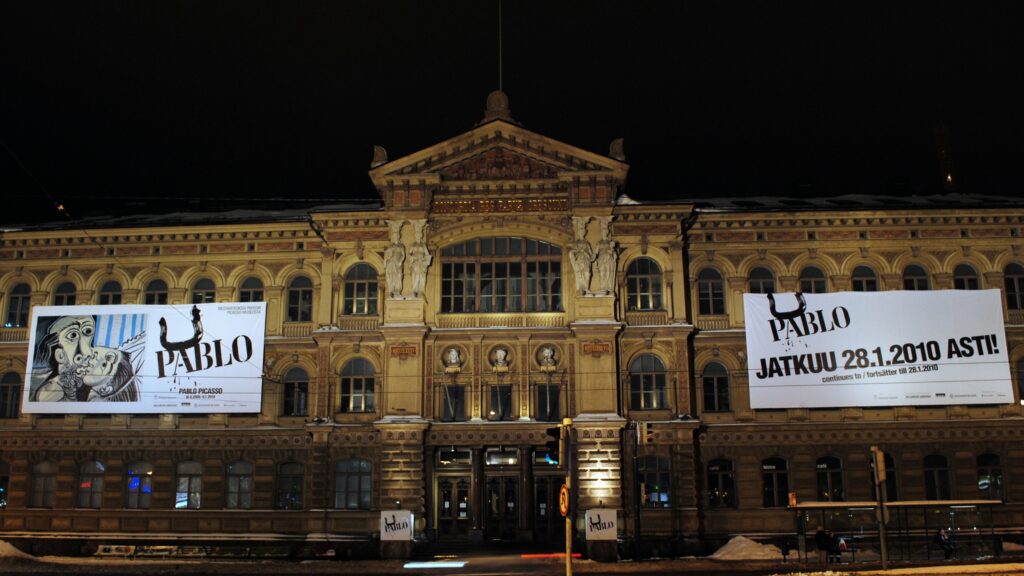
Image: the Ateneum Art Museum in Helsinki, venue of the exhibition. Contextual photograph; it does not depict the exhibition or an artwork by Elga Sesemann. Photograph by Earth-Bound Misfit, I, 2009, via Wikimedia Commons, licensed under CC BY 2.0. No editorial modification apart from WordPress resizing.
.jpg)