

A public opening at Kunstmuseum St.Gallen’s Lokremise on 21 August introduced Emilija Škarnulytė’s immersive film-and-installation project, which turns a decommissioned nuclear site into a meditation on deep time, technological power and the unstable border between scientific evidence and speculative fiction.
Lithuanian artist and filmmaker Emilija Škarnulytė opened Arrow of Time at the Lokremise in St. Gallen, Switzerland, on Friday evening, 21 August 2026. The public vernissage launched an installation built from film, light and sculptural interventions. Emilija Škarnulytė’s Arrow of Time places audiences inside a landscape where documentary observation meets speculative fiction, and where human history is measured against geological and cosmic scales.
A reactor becomes an image of deep time
At the centre of the exhibition is material filmed inside Lithuania’s decommissioned Ignalina Nuclear Power Plant, a Soviet-era facility designed around the same reactor technology used at Chernobyl. One sequence follows a python moving across the controls of an abandoned command room. The encounter is visually uncanny, but its argument is precise: systems once associated with mastery and progress can quickly become ruins, habitats and archaeological evidence.
Škarnulytė uses that shift in scale to question the long afterlife of technological decisions. Radioactivity exceeds an individual lifespan; geological time exceeds political memory. Rather than present a single prediction, the installation holds wonder and unease together. Its moving images ask viewers to consider humanity as one element within larger ecological and planetary structures, not the fixed centre of them.
Film, light and sculpture reshape the Lokremise
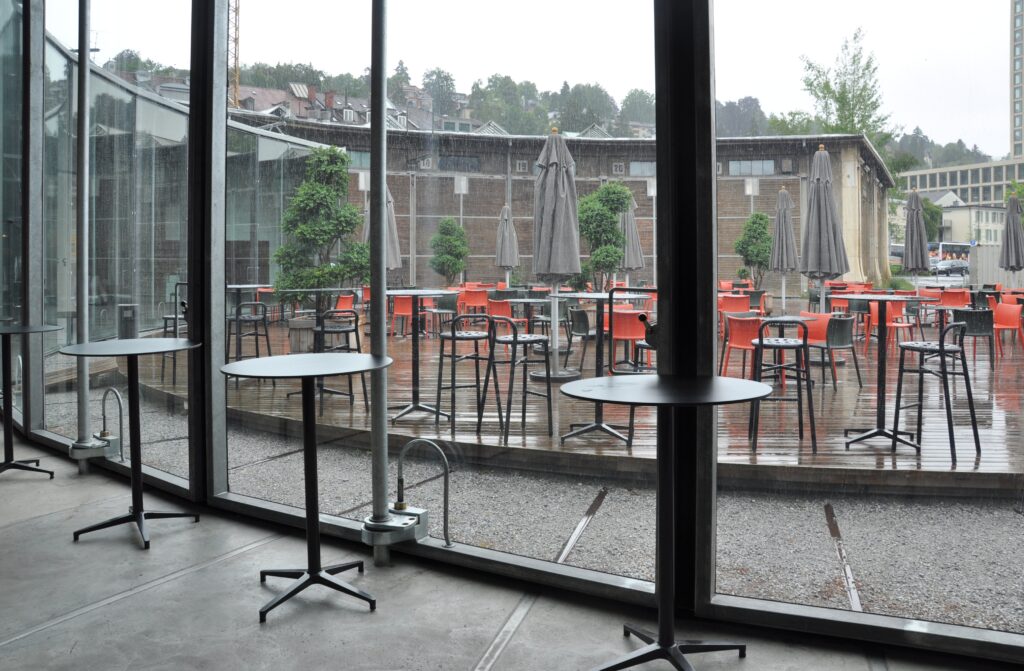
The circular industrial architecture of the Lokremise gives the project an unusually resonant setting. Once a railway engine depot, the building is now one of Kunstmuseum St.Gallen’s spaces for contemporary art. According to the venue’s programme, the opening ran from 6pm to 8.30pm with free admission. The museum’s current exhibition page already documents the completed 2026 installation, confirming that the project moved beyond announcement into a realised public presentation.
The exhibition also extends a practice in which Škarnulytė moves between scientific sites and imagined futures. Her films have travelled through deep-sea zones, submerged cities and landscapes marked by extraction or Cold War infrastructure. An e-flux overview situates the St. Gallen project within her wider interest in the entanglement of human, ecological and cosmic systems.
An opening framed by uncertainty
What makes the new presentation timely is its refusal to turn complex science into a simple cautionary tale. Control rooms, reactors and cinematic effects remain seductive even as they expose political failure and environmental risk. Emilija Škarnulytė’s Arrow of Time therefore treats uncertainty as a productive condition: a space in which beauty can sharpen, rather than soften, questions about responsibility.
Arrow of Time remains at Kunstmuseum St.Gallen Lokremise until 8 November 2026.
Featured image: interior view of the Lokremise in St. Gallen, photographed by Andreas Praefcke on 29 June 2013. Public domain; source: Wikimedia Commons. This contextual photograph does not show Arrow of Time, its 2026 opening or Emilija Škarnulytė.
