
On 1 October, the British Museum opened Korea: 2,000 years of creativity, a century-spanning exhibition that asks visitors to see Korean art not as a sequence of isolated dynasties but as a continuous argument about craft, belief and survival. The show brings 100 works to London, many from the national collection formed by the 2021 Lee Kun-hee bequest.
A collection built across dynasties
The official exhibition begins around 300 BC and moves through the Three Kingdoms, Unified Silla, Goryeo and Joseon periods before reaching the present. Ritual bronzes, Buddhist sculpture, celadon, lacquer, calligraphy and painting establish how Korean makers absorbed ideas from neighbouring cultures while developing highly distinctive forms.
Its scale is unusually concentrated. According to the opening account, the display includes ten National Treasures and thirteen Treasures of Korea; more than twenty objects are being shown internationally for the first time. Newly travelled works include bronze ritual objects, a celadon incense burner with a mythical girin-shaped lid, and modern pieces by Nam June Paik, Lee Jung-seop and Park Rehyun.
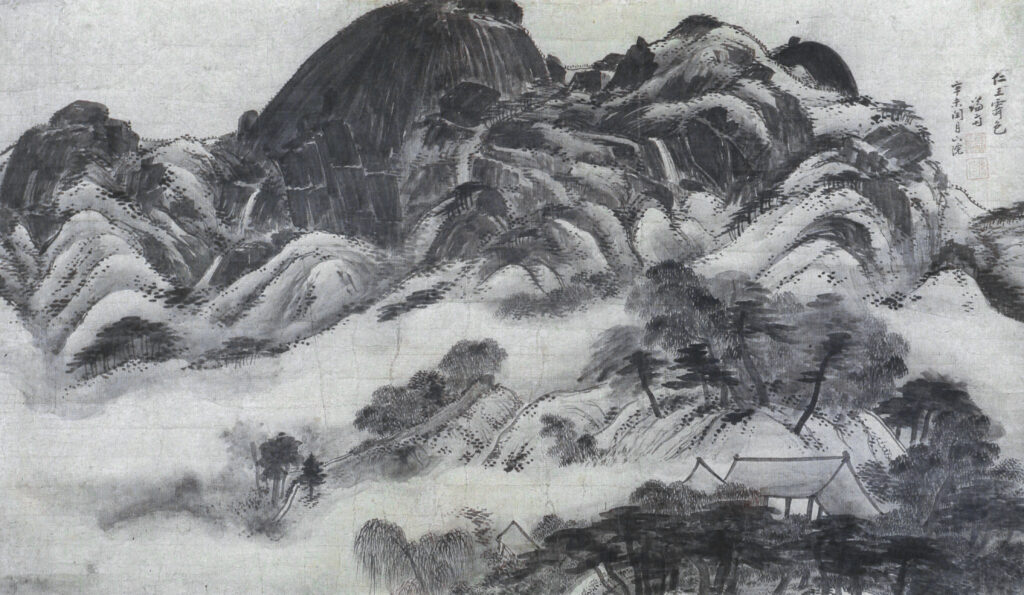
At the centre of that long history stands Jeong Seon’s 1751 ink landscape Clearing After Rain on Mount Inwang. Its wet, dark mountain mass emerges above quick, blurred trees, turning a familiar Seoul landmark into a study of atmosphere after a storm. The Guardian’s review identifies it as the exhibition’s most powerful encounter with Korea’s landscape tradition.
Beauty, rupture and the modern century
The exhibition’s chronological sweep also creates a difficult turn. Centuries of Buddhist, courtly and scholarly production give way to colonisation, war, division and rapid industrial change. Lee Jung-seop’s images of separation bring personal grief into the gallery, while Do Ho Suh’s contemporary work places an individual figure beneath the memory of a traditional house.
That transition has divided critics. The Guardian argues that the modern section is too compressed to carry the weight of Korea’s twentieth-century history. The Financial Times similarly praises the visual and technical range while noting political gaps. Their criticism matters because the show’s beauty can otherwise make cultural continuity look smoother than it was.
Even with those omissions, the London presentation is a major act of access. Drawn largely from a 23,000-object public bequest and organised with the National Museum of Korea and the National Museum of Modern and Contemporary Art, Korea, it follows earlier stops in Washington and Chicago. In London, the works gain a new audience while retaining the tensions of a national story told through a collector’s legacy.
The exhibition also changes the scale at which many of these objects can be read. A chronological central route gives way to focused rooms on individual dynasties, letting minute technical decisions in metal, glaze, ink and lacquer sit beside shifts in ritual and political authority. That structure makes craftsmanship the connective tissue of the story rather than a decorative afterthought.
Korea: 2,000 years of creativity runs at the British Museum through 31 January 2027.
Image credit: Jeong Seon, Clearing After Rain on Mount Inwang, 1751, ink on paper. Faithful reproduction of a public-domain work, Public Domain Mark 1.0, via Wikimedia Commons. The painting is included in the exhibition.
