

Bilbao Fine Arts Museum reopened its full complex to the public on 6 October, completing the four-year transformation led by Foster + Partners and Bilbao architect Luis María Uriarte. The first visitors entered a museum that is larger, easier to navigate and newly organised around its own architectural history.
Called Agravitas, the intervention does not replace the institution’s earlier buildings. It lifts a long, ribbed volume above them, reconnecting the museum’s 1945 neoclassical home, its 1970 modernist extension and later additions. That decision turns the reopening into more than an expansion: it makes the museum’s accumulated architecture part of the visit.
A museum built in layers
The museum’s official project brief records 6,743 square metres of new construction and the remodelling of another 8,000. The completed scheme adds 2,300 square metres of exhibition space, including a large column-free gallery for temporary shows, while creating new areas for education, design, research and sculpture.
Agravitas works structurally as a bridge. Its white steel volume spans 55 metres between major supports, while large V-shaped columns hold it above the protected buildings. At ground level, the former outdoor Plaza Arriaga has become a covered atrium of roughly 1,000 square metres. A six-metre oculus connects this public space visually with the gallery above and frames Francisco Durrio’s monument to composer Juan Crisóstomo de Arriaga.
The architecture also restores the original entrance of the 1945 building. From there, visitors can move through a continuous sequence rather than treating each construction phase as a separate museum. Natural light, solar protection and more than 500 square metres of photovoltaic panels form part of the environmental strategy.
A collection retold
The reopening also unveils Bildu(e)mak, a display of close to 1,000 works arranged across 43 galleries. More than 150 pieces are newly acquired or have not previously been shown in this context. The chronological route runs from older European art through modern and contemporary practice, while works by women are integrated throughout instead of isolated in a separate corrective section.
That curatorial reset gives the building’s new connections a parallel inside the collection. Renaissance painter Sofonisba Anguissola, Goya, Gauguin, Francis Bacon, Eduardo Chillida and contemporary Basque artists now occupy a broader story shaped by loans, recent gifts and the museum’s own holdings.
Opening-day reporting from El País followed Norman Foster through the completed spaces, while Deia documented local residents and international visitors entering during the first public hours. Their accounts confirm that the reopening happened as scheduled, after an official ceremony on 5 October.
The museum is offering free admission through 13 October. After years of building above and around its existing fabric, Bilbao Fine Arts Museum has not emerged as a single new object. Agravitas instead makes its different eras readable at once—and gives the collection room to change with them.
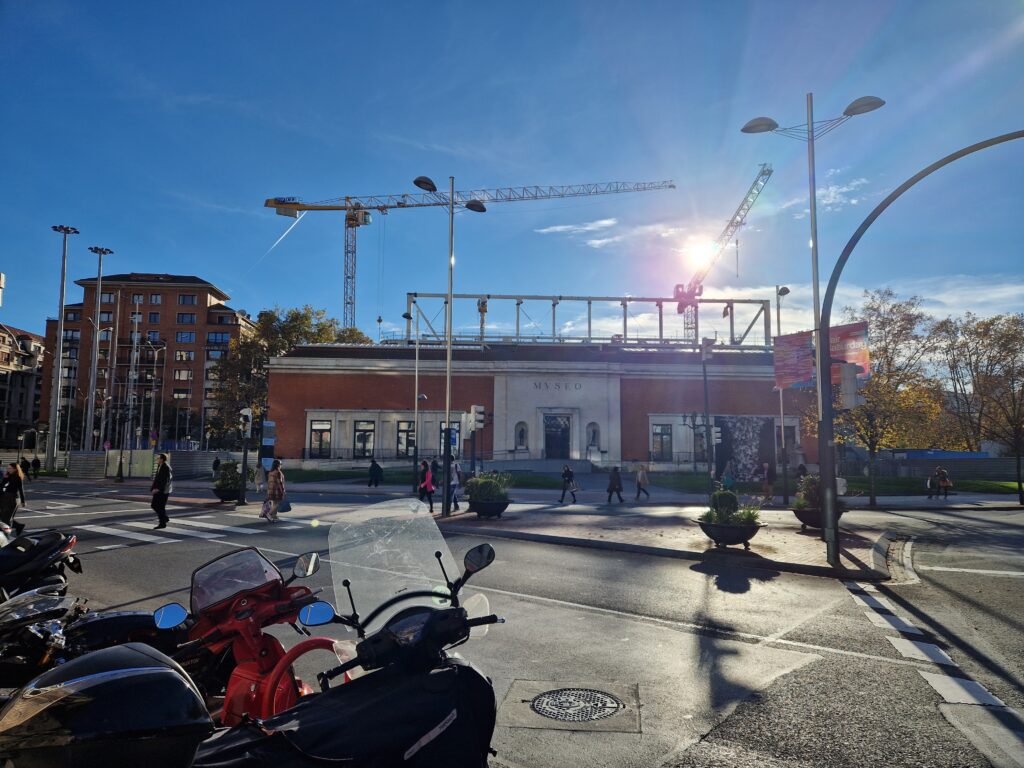
Featured image: the Agravitas extension of Bilbao Fine Arts Museum under construction, 27 November 2024. Photograph by Xabier, CC0 1.0, via Wikimedia Commons. The photograph shows the exact building discussed but predates its completion and the 2026 reopening.
.jpg)