
The Nationalmusée um Fëschmaart inaugurated From Renoir to Monet on 8 October, bringing the Rau Collection’s Impressionist paintings into dialogue with works held in Luxembourg.
Claude Monet’s storm-beaten Breton coast opened a new conversation in Luxembourg on Thursday evening. The From Renoir to Monet: Impressionism from the Rau Collection exhibition was inaugurated at the Nationalmusée um Fëschmaart on 8 October and opens to the public on 9 October, remaining on view until 4 April 2027.
The exhibition combines paintings from the Collection Rau for UNICEF with works from the museum’s own holdings. Rather than treating Impressionism as a single, settled style, curator Ruud Priem has organised the display across six themes, including landscape, portraiture, photography, artists at work and the movement’s longer afterlife. A report from the opening described how the arrangement follows the ways painters responded to rapid social and technological change.
A coastline painted against the weather
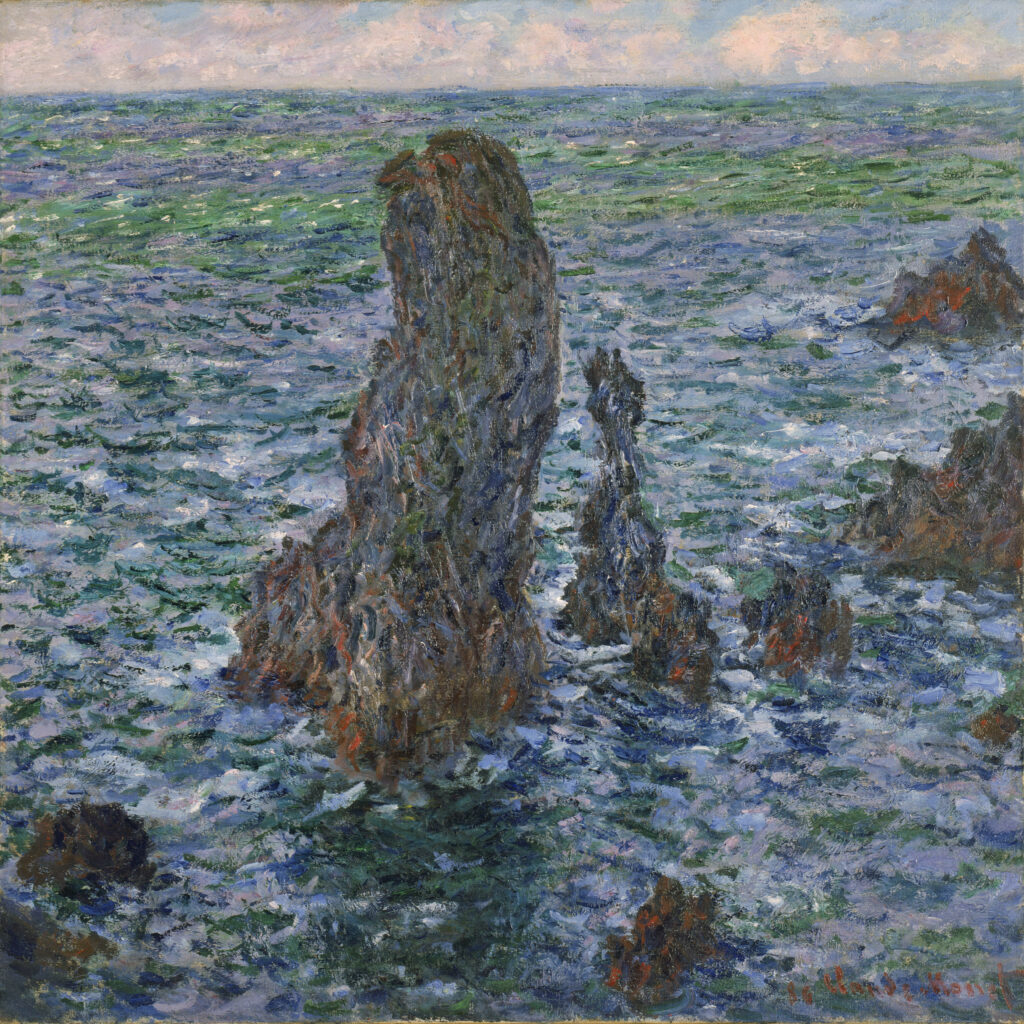
Among the works is Monet’s The Pyramids of Port-Coton, painted in 1886 during his stay on Belle-Île-en-Mer. Monet repeatedly returned to the island’s rock formations and rough Atlantic water, setting up his easel in difficult weather to observe changing light. In this version, the horizon is compressed while the cliffs and sea occupy almost the entire square canvas, turning direct observation into a tightly constructed field of colour and movement.
The painting is joined by Auguste Renoir’s Woman with a Rose, Paul Signac’s The Sea. Opus 211, Gustave Caillebotte’s Snowy Roofs in Paris and Mary Cassatt’s Louise, Nursing Her Child, all identified on the exhibition’s dedicated website. Together, they extend the familiar narrative beyond open-air landscapes, connecting technical experiment with portraiture, domestic life and the altered visual habits introduced by photography.
A collection moves through institutional exchange
The show also reveals the unusual public life of the Rau Collection. Gustav Rau, a physician and philanthropist, assembled the holdings over four decades and left them to UNICEF after his death in 2002. The collection, numbering 279 paintings according to the opening report, is held on long-term loan at the Arp Museum Bahnhof Rolandseck in Germany.
This presentation is part of a two-way exchange. While Impressionist works from Remagen have travelled to Luxembourg, Old Masters from the Nationalmusée have gone to the Arp Museum for Talking Pictures 1400–1800. The pairing shifts attention from ownership to circulation: paintings that usually belong to separate institutional narratives can be read through temporary relationships.
That exchange gives the Luxembourg exhibition its strongest purpose. It is not simply a sequence of recognised names, but a study of how collections are activated when museums lend, reframe and place them beside unfamiliar neighbours. Monet’s turbulent coast becomes both an anchor and a threshold—an image of instability used to open a broader account of modern vision.
From Renoir to Monet: Impressionism from the Rau Collection is at the Nationalmusée um Fëschmaart in Luxembourg through 4 April 2027.
Image: Claude Monet, The Pyramids of Port-Coton, 1886, oil on canvas, Collection Rau for UNICEF / Arp Museum Bahnhof Rolandseck. Public domain. Reproduction via Wikimedia Commons, Public Domain Mark 1.0.
