

Claude Monet spent a lifetime testing whether paint could hold a moment. On 30 September, the Musée de l’Orangerie opened Monet, peindre le temps, an exhibition that makes that pursuit its organising idea and places it beside the artist’s final, room-sized answer: the Nymphéas.
Created for the centenary of Monet’s death, the exhibition brings together nearly forty paintings, chiefly from the Musée d’Orsay and the Musée Marmottan Monet, with loans from public and private collections. A photographic report published on opening day confirms the exhibition in place, tracing a route from plein-air landscapes to the late water lilies.
A clock built from repeated motifs
The show begins with a historical pressure that is easy to overlook in familiar Impressionist pictures. Monet worked as public clocks multiplied, railway timetables synchronised daily life and faster transport remade the experience of distance. His brisk brushwork and shifting light were not merely stylistic signatures; they were ways of registering a world newly conscious of minutes, weather and change.
That inquiry sharpened in the 1890s, when Monet repeatedly painted the same subjects under different conditions. Haystacks, poplars along the Epte, Rouen Cathedral and mornings on the Seine became sequences rather than isolated views. Each canvas fixes an appearance, yet the group reveals that no appearance remains stable. Repetition does not settle the motif. It turns seeing into a measure of passing time.
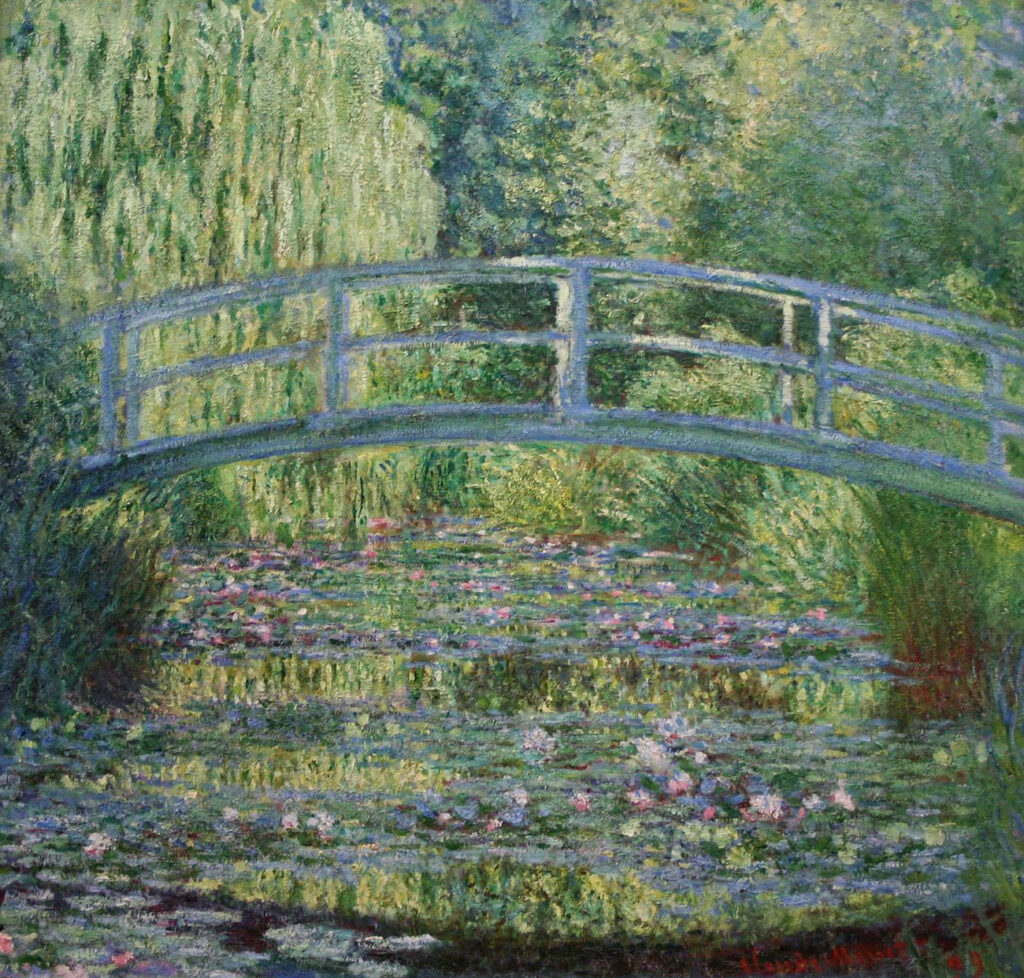
Le Bassin aux nymphéas, harmonie verte, painted in 1899 and used by the Orangerie to introduce the exhibition, carries that method into Monet’s garden at Giverny. The Japanese bridge gives the composition a firm arc, but foliage, reflections and water blur the divisions between object and atmosphere. The work is not simply an image of a pond; it records the pond becoming different as light moves through it.
From the instant to duration
The final section changes scale and rhythm. Monet made more than 250 paintings around the Nymphéas motif, eventually designing the vast panels that occupy two oval rooms at the Orangerie. Installed in 1927, one year after his death, they surround the viewer instead of presenting a succession of framed moments. The museum describes this shift as a move from fragmented time toward a continuum.
That transition gives the exhibition unusual coherence. Its temporary galleries can show how Monet dissected time through series, while the permanent rooms let visitors experience his attempt to dissolve those divisions. The familiar Nymphéas become less a decorative endpoint than the conclusion of a decades-long argument about attention, memory and duration.
Monet, peindre le temps runs in Paris through 25 January 2027 before travelling to Tate Modern in London from 25 February to 27 June. The centenary framing could have produced a conventional retrospective. Instead, the exhibition asks a more precise question: what happens when an artist returns to the same world often enough to show that it never truly stays the same?
Image credit: Claude Monet, Le Bassin aux nymphéas, harmonie verte (The Water Lily Pond: Green Harmony), 1899, Musée d’Orsay. Faithful reproduction of a public-domain artwork, Public Domain Mark 1.0, via Wikimedia Commons. The painting is presented in the 2026 exhibition; this image is not a photograph of the installation.
