
On Sunday, the Southbank Centre became a resonating map of Steve Reich’s influence. Across two London performances on 27 September, Paraorchestra, the London Sinfonietta and guitarist Jonny Greenwood marked the American composer’s approaching 90th birthday by returning his music to its elemental materials: breath, pulse, repetition and the changing attention of a room.
The festival finale arrived six days before Reich turns 90 on 3 October and in the 50th-anniversary year of Music for 18 Musicians. It was not simply a birthday tribute. The day showed how music written across five decades can still alter the social space around it, whether listeners are moving among performers or watching a concert ensemble transform recorded city noise into rhythm.
A landmark score without a stage
Paraorchestra placed Music for 18 Musicians in the Southbank Centre’s Clore Ballroom, with players distributed through the open space and listeners free to settle among them. The arrangement made an essential quality of the 1976 score visible: no single line dominates for long. Voices, clarinets, strings, pianos and percussion pass a living pulse between one another while harmonies change almost imperceptibly.
The work’s structure is rigorous, but its effect depends on bodies breathing together. Reich built its cycle from 11 chords, allowing each one to expand into a section before the opening sequence returns. In this performance, proximity turned that architecture into a physical experience. Listeners could hear patterns sharpen, blur and migrate as they changed position.
That spatial approach also aligned with Paraorchestra’s wider practice of reconsidering how concerts are staged and who can participate in them. Rather than treating accessibility as an adjustment made after the music, the performance made freedom of movement part of the listening itself.
A language carried forward
Later in the Royal Festival Hall, the London Sinfonietta and Greenwood traced Reich’s vocabulary across different periods. The programme set the spare human mechanism of Clapping Music beside Pulse, Radio Rewrite, Electric Counterpoint and City Life. Repetition never meant stasis: each piece used a fixed process to produce shifts in colour, density and perception.
Greenwood’s performance of Electric Counterpoint connected Reich’s concert language to a musician whose work moves between rock, film scores and contemporary composition. City Life pushed in another direction, weaving sampled urban sounds into the ensemble so that speech fragments, horns and street noise became musical material.
A review published the following day found the two events capable of renewing familiar scores rather than enclosing them in commemoration. That distinction matters. Reich’s influence is often described through technique—phasing, looping and interlocking rhythm—but Sunday’s performances made it social. The music asked audiences to notice how individual actions accumulate, how repetition changes under pressure and how a shared pulse can hold many different perspectives at once.
The Southbank celebration therefore looked forward as much as backward. At 90, Reich’s work remains less a monument than a set of tools: precise enough to endure, open enough for new performers and listeners to inhabit.
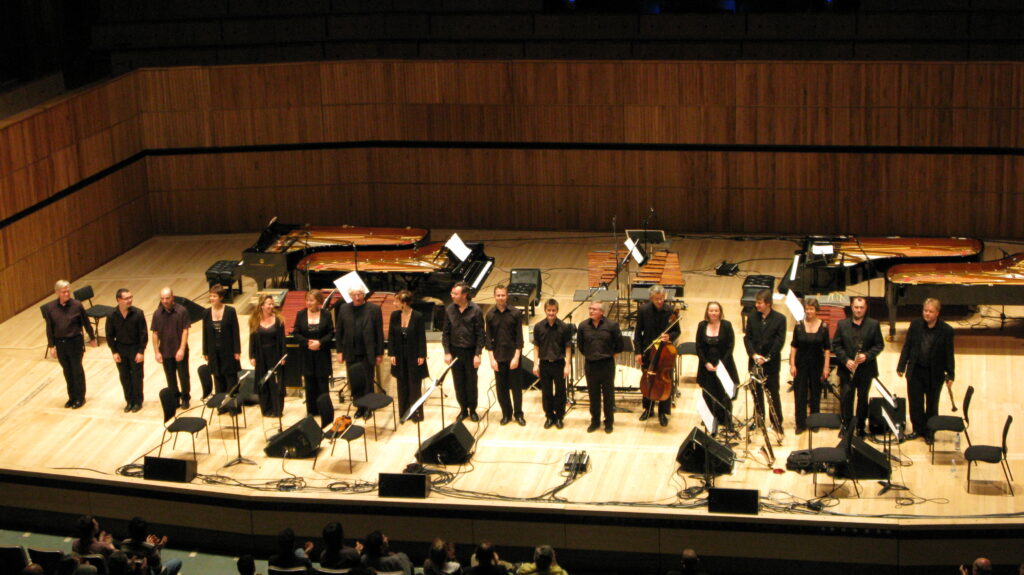
Image: The London Sinfonietta performing Steve Reich’s Music for 18 Musicians at the Royal Festival Hall on 28 April 2008. Photograph by Flavio Ferrari, CC BY-SA 2.0, via Wikimedia Commons. This historical photograph predates the 2026 festival and does not show either performance reviewed here.
