
On 7 October, the Louvre opened Zurbarán 1598–1664, bringing one of the Spanish Golden Age’s most distinctive painters into the Hall Napoléon. The Paris presentation follows the exhibition’s run at London’s National Gallery and precedes its move to the Art Institute of Chicago in 2027. Rather than attempting an exhaustive survey, it assembles an ambitious selection that makes the case for Francisco de Zurbarán as more than a severe painter of monks and martyrs.
A Spanish master beyond austerity
The retrospective is the result of a collaboration between the three museums. It is organised in seven chronological and thematic sections, moving from the artist’s early naturalism to the monumental commissions that established his reputation in Seville, then through portraiture, still life and his later experiments with colour. Paintings by his son, Juan de Zurbarán, extend the story into a short-lived but accomplished second generation.
For an artist so closely associated with Counter-Reformation Spain, the exhibition stresses how modern Zurbarán can look. His figures are built from simplified volumes; fabrics become fields of white, crimson or green; isolated objects command dark spaces with an almost sculptural force. That economy helps explain his later appeal to artists working in France, including Édouard Manet, Pablo Picasso and Juan Gris.
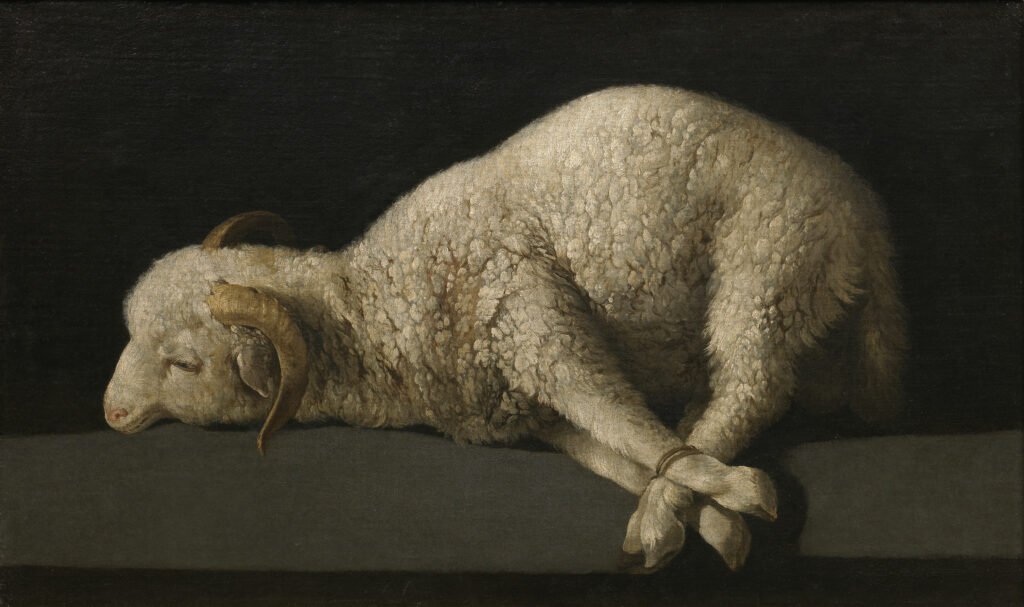
One of the clearest examples is Petit mouton, formerly known as Agnus Dei, painted around 1635–40 and lent by the Museo del Prado. A living lamb lies bound on a grey table against darkness. The motif can be read as a still life, yet its sacrificial charge remains immediate. The Louvre’s own study of the picture notes how the animal’s horns distinguish it from explicitly haloed versions while the meticulous fleece and concentrated gaze intensify its emotional power.
Painting beside sculpture
The exhibition also shares a ticket and a jointly designed setting with Sculpting Colour, a display of 17th-century Spanish polychrome sculpture. That pairing matters: Zurbarán’s paintings often make bodies and garments feel carved before light and pigment restore their physical presence. Visitors can compare how painters and sculptors turned devotion into an encounter with texture, weight and illusion.
The Louvre describes this as the first large-scale international presentation devoted to Zurbarán since the Metropolitan Museum of Art and Grand Palais exhibition of 1987–88. Critical responses to the London stage focused on the painter’s tension between austerity and sensual precision, especially in his still lifes and white-robed saints. In Paris, the exhibition reframes that achievement through the Louvre’s own history and through the avant-garde artists who found new possibilities in his compressed spaces and lucid silhouettes.
Running until 25 January 2027, Zurbarán 1598–1664 offers a rare opportunity to see works normally dispersed across European and American collections. Its argument is quiet but forceful: stillness was not a limitation in Zurbarán’s art. It was the device that made colour, flesh and faith appear newly present.
Image credit: Francisco de Zurbarán, Petit mouton (formerly Agnus Dei), 1635–40, Museo Nacional del Prado, P007293. Faithful reproduction via Wikimedia Commons. Public Domain Mark 1.0.
