
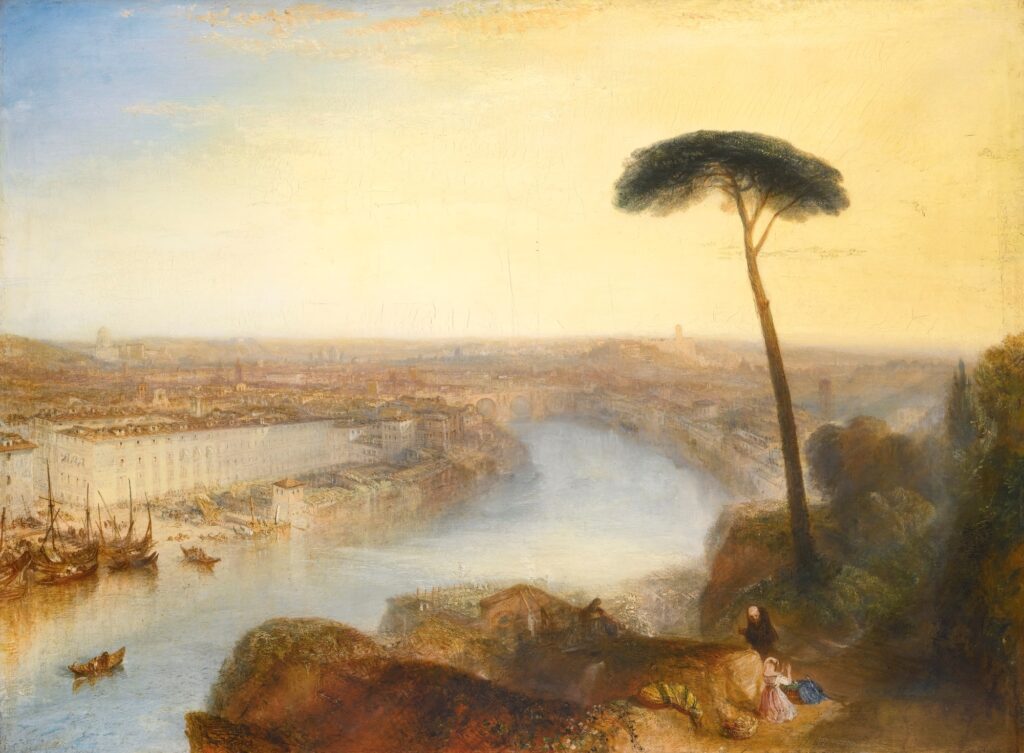

Nearly two centuries after J. M. W. Turner transformed Rome into a haze of gold, Rome, From Mount Aventine has returned to the city that shaped it. Sotheby’s unveiled the celebrated landscape at Palazzo Rondinini on 29 September, opening its first public display in Rome.
The three-day presentation places one of Turner’s most important privately owned paintings within walking distance of the view that inspired it. It also offers a rare chance to examine a surface that has survived with unusual clarity before the work resumes an international preview tour and heads to auction in London on 9 December.
A modern Rome made from memory
Turner first visited Rome in 1819 and returned in 1828, filling sketchbooks with the city’s river, ruins and shifting atmosphere. For this painting, he combined several studies rather than copying one fixed viewpoint. The result opens from the Aventine Hill across the Tiber, with the broken Ponte Emilio, distant domes and an umbrella pine dissolving into morning light.
Commissioned by Turner’s friend and patron Hugh Andrew Johnstone Munro of Novar, the painting was completed in the mid-1830s and first exhibited at the Royal Academy in 1836. Unlike Turner’s visions of ancient Rome, it presents the city as he knew it, making the work both an imagined panorama and a record of contemporary experience.
That tension between observation and invention becomes visible in the paint itself. According to Sotheby’s specialist Julian Gascoigne, Turner built translucent glazes beside dense impasto, scraped passages with a palette knife and sometimes used his fingers. Because the canvas has never been relined, those marks remain unusually legible, preserving a direct sense of the artist’s physical process.
A masterpiece briefly re-enters public view
The picture stayed with Munro until 1878, when Archibald Primrose, the future British prime minister and fifth Earl of Rosebery, acquired it. It then remained in the Rosebery family for more than a century. When Sotheby’s sold it in 2014 for £30.3 million, it set an auction record for Turner that still stands.
Its return now carries a double significance. Rome can see the painting publicly for the first time, while the art market prepares to test the value of a late Turner still outside a museum collection. Sotheby’s expects about £50 million, a figure that would surpass the artist’s existing record if achieved.
Yet the display’s strongest argument is not financial. Seen in Rome, the painting reconnects a private object with the public landscape behind it. The Tiber, bridges and skyline no longer function only as provenance or backdrop; they become active participants in how the work is read.
After the Rome presentation closes on 1 October, the painting will travel to further international previews before the December sale. For three days, however, Turner’s luminous city has been allowed to face its source—an encounter between place, memory and paint that the work had waited almost 200 years to make.
Image credit: J. M. W. Turner, Rome, From Mount Aventine, c. 1835. Faithful reproduction of a public-domain artwork, Public Domain Mark 1.0, via Wikimedia Commons. The image depicts the exact painting shown in Rome; it is not a photograph of the 2026 display.
