
On October 4, the Kimbell Art Museum in Fort Worth opened Photography’s First Century: Masterworks from the Bibliothèque nationale de France, the first exhibition in the museum’s history devoted to photography. More than 150 images carry visitors from the medium’s experimental beginnings in the 1840s to the restless modernism of the interwar years.
Organized with the Bibliothèque nationale de France, the exhibition draws on a collection assembled almost alongside photography itself. The result is not simply a procession of famous names. It shows how a scientific novelty became a language for art, travel, industry, celebrity and urban memory.
An invention becomes an art
The opening galleries return to the competing technologies that defined photography’s first decades. Daguerreotypes offered startling detail on metal plates; calotypes introduced the paper negative and the possibility of multiple prints. Among the early landmarks are Charles Hugo’s portrait of his father, Victor Hugo, Joseph-Philibert Girault de Prangey’s architectural views, Henri Le Secq’s paper negatives and Eugène Cuvelier’s studies of the Forest of Fontainebleau.
As the medium learned to describe the modern world, photographers also learned to shape it. Nadar used calibrated light to give writers, musicians and actors a new public presence. Édouard Baldus followed the expansion of the railway, while Louis-Émile Durandelle documented the construction of the Paris Opéra. Their images made engineering and architecture look both factual and theatrical.
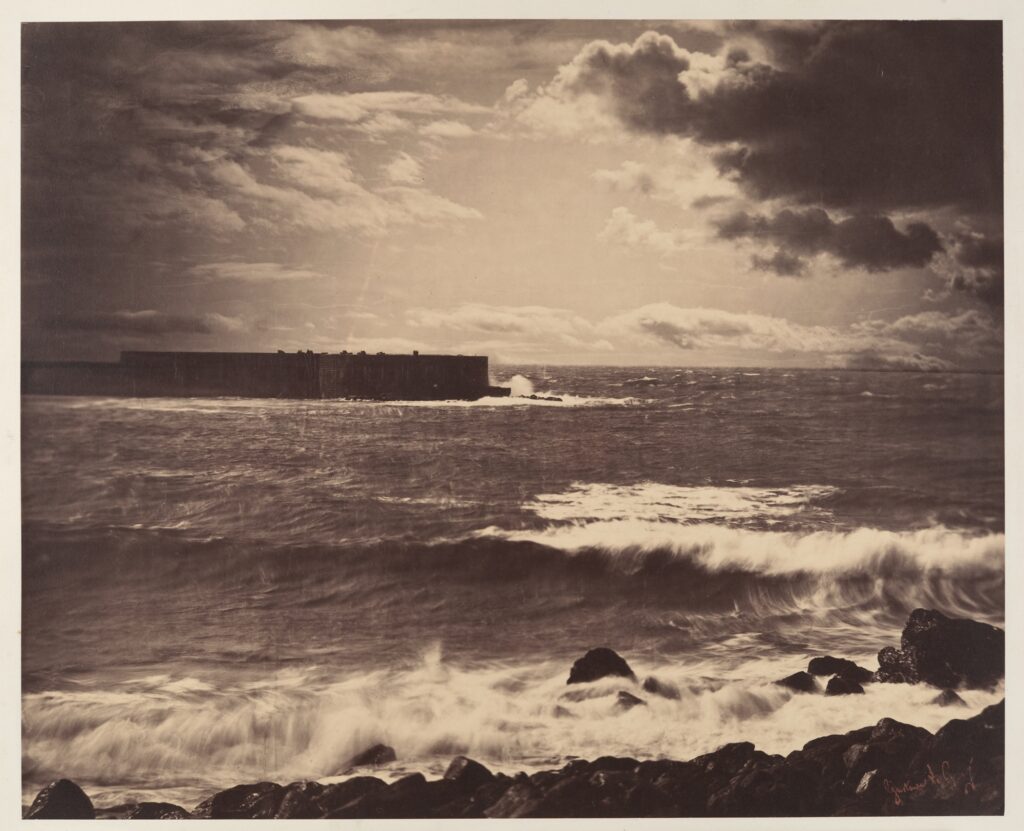
Gustave Le Gray’s The Great Wave, Sète crystallizes that double ambition. Created in 1857 from separate negatives for sea and sky, the photograph solved a technical problem while turning weather and water into a sublime composition. A work once dependent on chemical ingenuity now reads with the immediacy of a modern image.
A century gathers speed
The exhibition’s later chapters follow photography into private albums, changing streets and avant-garde circles. Eugène Atget records the fragile fabric of old Paris. Man Ray, André Kertész, Rogi André and Brassaï use the camera as an instrument of experiment, intimacy and nocturnal discovery. Portraits of Sonia Delaunay and Pablo Picasso reveal how photography became inseparable from the construction of artistic identity.
That breadth matters at the Kimbell, whose celebrated collection has never before been reframed through photography. The museum’s inaugural survey arrives as France prepares to mark the bicentennial of the medium’s invention, giving the American presentation a wider historical charge. It also demonstrates the unusual continuity of the BnF holdings: an archive formed during photography’s birth can still tell the story of its transformation. By placing technical breakthroughs beside cultural change, the exhibition makes that history feel less like a timeline than a chain of creative decisions.
Photography’s First Century runs at the Kimbell Art Museum through January 17, 2027. Its argument is quietly expansive: before photography became ubiquitous, it had to be invented again and again—technically, artistically and socially.
Image credit: Gustave Le Gray, The Great Wave, Sète, 1857. Albumen silver print from glass negative. Public Domain Mark 1.0, via Wikimedia Commons. This reproduction derives from a print held by The Metropolitan Museum of Art; the Kimbell exhibition presents a BnF print of the same photograph.
