
On Sunday, old master paintings began speaking across borders in Remagen. Talking Pictures: Masterpieces from 1400 to 1800 from the National Museum of Luxembourg opened at the Arp Museum Bahnhof Rolandseck on 27 September, setting around 30 works from Luxembourg’s Nationalmuseum in dialogue with Renaissance and Baroque holdings from the Rau Collection for UNICEF.
The exhibition asks a direct question: how did pictures tell stories before cinema, photography or the endless scroll? Its answer unfolds through four centuries of sacred history, mythology, landscape and everyday life. Rather than arranging paintings as isolated trophies, curator Susanne Blöcker builds encounters between collections and between different modes of narration.
For the Luxembourg museum, the presentation is exceptional: its historical and genre paintings are being shown together in such depth outside the country for the first time. Rolandseck makes that temporary concentration the exhibition’s starting point.
A four-century conversation
The earliest works turn the life of Christ into a sequence of vivid episodes, using precious ivory panels and large altarpieces to make belief visible. With Humanism and the Counter-Reformation, the drama moves closer to the body. Faces, gestures and the suspended instant before action become the engines of a story.
Rosso Fiorentino’s Bacchus, Venus, and Cupid, painted around 1535–39, captures that charged theatricality and supplies the exhibition’s title image. Nearby examples include Lucas Cranach the Elder’s Caritas, Abraham Bloemaert’s nocturnal Cupid Surprises Psyche, Jacob Jordaens’s Bacchus and a Follower, and Francisco de Burgos Mantilla’s scene of two peasants before a table.
The exhibition then follows a shift after the mid-17th century. Grand histories gradually give way to landscapes and scenes of ordinary life. Nature becomes an actor in its own right, while genre painting treats work, appetite and social behavior with tones that range from sober observation to comedy.
An exchange between two collections
Talking Pictures is one half of a cross-border collection exchange. While Luxembourg’s Old Masters travel to Rolandseck, works from the Rau Collection—including paintings by Monet, Renoir and Cassatt—will be shown at the Nationalmuseum in Luxembourg from October. The arrangement places two institutions and two collecting histories in conversation rather than simply sending a touring package from one venue to another.
Sunday’s opening formed part of a free museum festival, with hourly exhibition tours, a comic-drawing workshop and the Käpt’n Book children’s reading festival. That family programme echoed the exhibition’s central idea: images and words do not merely illustrate stories; they shape how those stories are remembered.
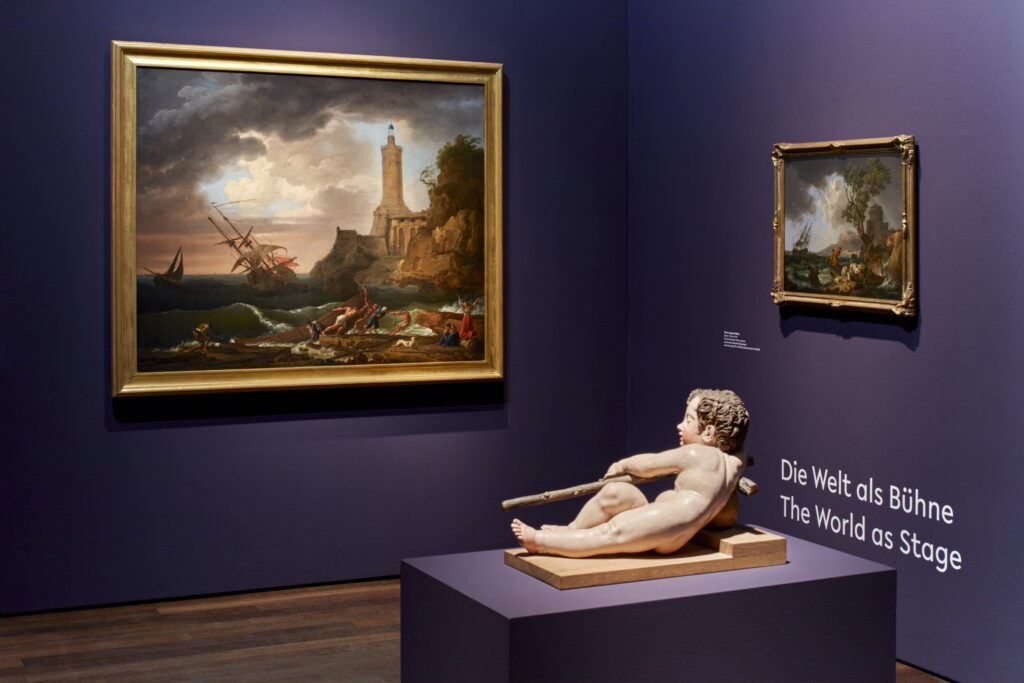
Installed against deep violet walls, the paintings appear less like distant relics than actors sharing a stage. Across myth, scripture and ordinary life, the exhibition reveals storytelling as an art of selection—deciding which moment to freeze, whose gesture to amplify and what the viewer must imagine next.
Talking Pictures runs at the Arp Museum Bahnhof Rolandseck in Remagen through 4 April 2027.
Image: Installation view of Talking Pictures, Arp Museum Bahnhof Rolandseck, 2026. Photo: Mick Vincenz. Courtesy Arp Museum Bahnhof Rolandseck. Used for editorial reporting under the museum’s press-image terms.